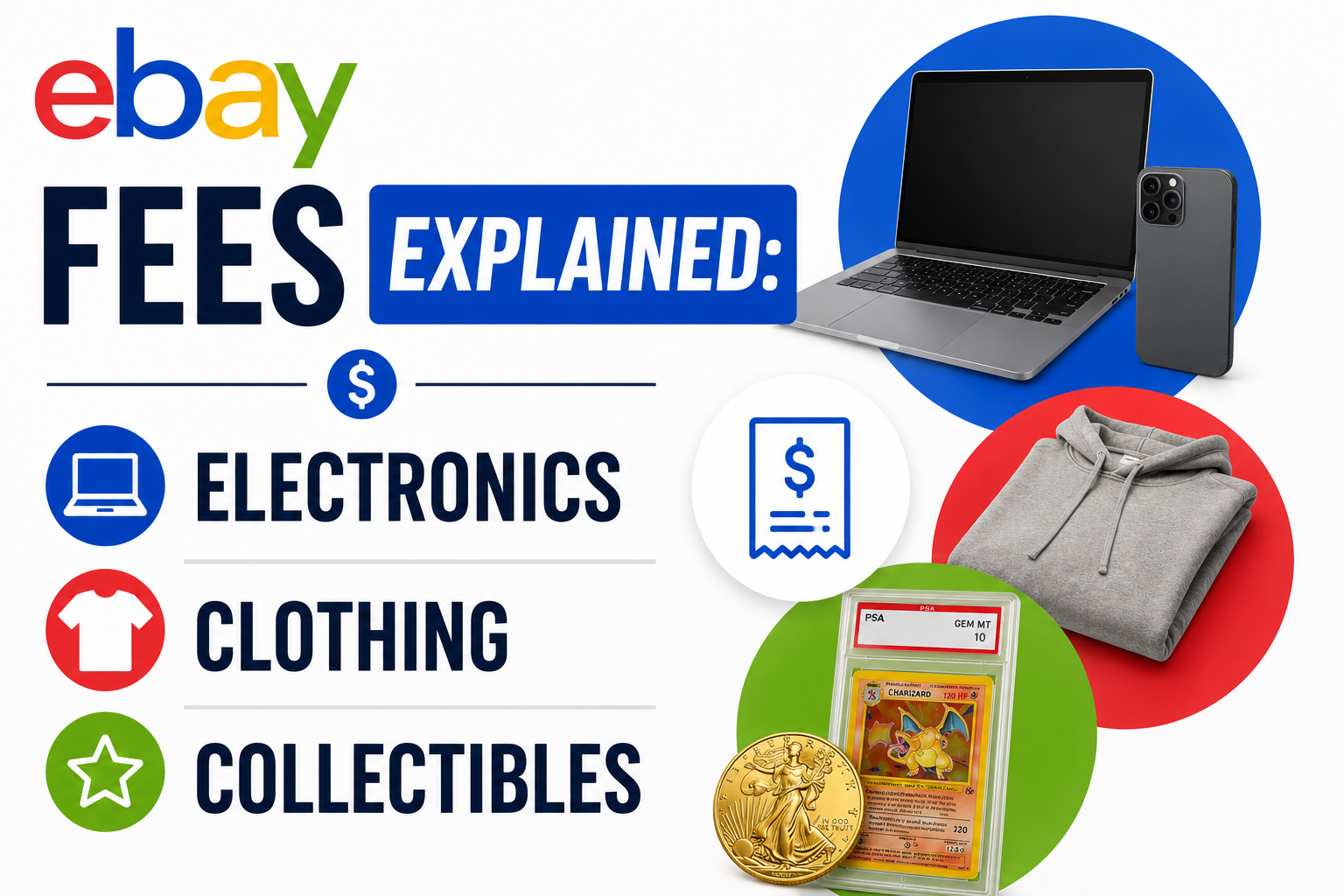
eBay Fees Explained: Electronics, Clothing & Collectibles
Compare eBay fees across categories like electronics, clothing, and collectibles to maximize profits. Learn strategies to minimize costs with our expert guide.
Calculate Your eBay Selling Fees
Our free eBay Fee Calculator automatically calculates final value fees, promoted listing fees, international fees, regulatory fees, store subscription discounts, and different category-specific fee structures. See your estimated eBay fees, profit, and profit margin in seconds before you list.
Open Free eBay CalculatoreBay Fees by Category: A Guide to Electronics, Clothing, and More
A guitar and a comic book can sell for the exact same price and still leave you with wildly different payouts—because eBay's final value fee is not one flat number. It varies by category, sometimes significantly. Heavy equipment sellers pay as little as 3%. Book and media sellers pay 15.3%. Everything else lands somewhere in between, often with its own quirks: sneakers receive a fee cut past $150, jewelry steps down at higher price tiers, and guitars are quietly one of the cheapest categories on the entire platform.
If you are pricing without knowing which bucket your item falls into, you are guessing at your own margin. This guide provides a structured, data-driven breakdown of eBay's category-specific fee structures, with practical strategies for optimizing your category selection and calculating your true net proceeds before listing.
Key Takeaways
- eBay's fees are not one-size-fits-all. Category selection matters more than most sellers realize. A guitar seller paying 6.7% operates in a fundamentally different margin environment than a book seller paying 15.3%, even at identical price points.
- Check your category's actual rate before pricing anything. Rates vary significantly and shift periodically. Confirm current numbers through eBay Seller Center before finalizing a listing price.
- Sneakers have a $150 threshold. Pricing athletic shoes at $150 or more reduces the fee to 8% and waives the per-order fee. If the market supports it, crossing that threshold can meaningfully improve your margin.
- Store subscriptions pay for themselves in specific categories. If you sell in books, jewelry, electronics, or other high-fee categories, the rate discounts can offset the monthly subscription cost within a few sales.
- Run a calculator rather than guessing. A fee or profit calculator shows your exact net profit before you list, preventing unpleasant surprises after the sale.
- Treat category selection as a real pricing decision. When an item genuinely fits multiple categories, choose the one with the lower rate—but never mislabel to chase savings, as enforcement action can result in listing removal and account flags.
1. How Category Fees Actually Work
Every completed sale on eBay triggers a final value fee—a percentage of the total sale amount, which includes the item price and any shipping you charge the buyer. On top of that, eBay adds a small flat fee per order: $0.30 if the total sale is $10 or less, and $0.40 if it is above that.
The Category Variable:
What most sellers do not realize is that the percentage itself is not uniform. It is set by category, and many categories use a step structure—the full rate applies up to a certain price cap, then a lower rate applies above that. For sellers without an eBay Store subscription, that cap is commonly $7,500 per item. Store subscribers often see a lower cap, typically around $2,500, but benefit from a better starting rate.
The Total Sale Calculation:
The fee is calculated on the total amount the buyer pays, which includes the item price, shipping and handling charges, and any sales tax collected. This means every component of the transaction contributes to the fee calculation, and category selection affects the percentage applied to that total.
2. Electronics: Fair Rates for High-Turnover Items
Electronics is one of eBay's most active categories, and it is also priced reasonably. Most consumer electronics—cameras, gadgets, accessories—pay the standard 13.6% on the total sale up to $7,500 for non-Store sellers.
Cell Phone Exception:
Cell phones receive better treatment for Store sellers specifically. A Basic, Premium, Anchor, or Enterprise subscription drops the rate to 9% up to $2,500, then 2.35% above that. Memory cards for phones receive the same break.
The Financial Impact:
Running the math on a $200 camera sale yields approximately $27 in final value fees plus the $0.40 order fee—a manageable bite in a category where demand stays strong and stock turns over quickly. Prices shift often enough in electronics that it is worth checking a fee calculator before committing to a listing price, especially on anything time-sensitive.
3. Clothing, Shoes, and Accessories: The Sneaker Rule
This category covers an enormous range—old band tees, luxury handbags, sneakers, and everything in between—and the fee structure reflects that variety. Most items here sit at the standard 13.6% for non-Store sellers.
The Sneaker Exception:
Athletic shoes are the exception worth knowing about. Below $150, they are taxed at the normal rate. At $150 or above, the final value fee drops to 8%, and the per-order fee is waived entirely.
The Threshold Impact:
This is not a small difference. A $200 pair of limited-edition sneakers sold without a Store costs approximately $16 in fees, with no order fee attached. Drop that same pair to $140, and you are paying closer to $19 once the order fee is added—a higher fee on a lower sale price. If the market supports it, there is a real incentive to price sneakers at or above that $150 line rather than just under it.
Handbags and Luxury Items:
Handbags follow their own logic too. Non-Store sellers pay 15% up to $2,000, then 9% above that. This step structure rewards higher-priced handbag sales with a reduced rate above the threshold.
Category Complexity:
The takeaway here is that this category is not one rate wearing different labels. A $30 vintage jacket, a $200 designer bag, and a $180 pair of running shoes are all governed by different rules, and it is worth checking each one before you list.
4. Collectibles: Depends Heavily on What You Are Selling
"Collectibles" sounds like a single category, but eBay treats its subtypes quite differently. General collectibles—action figures, vintage toys, comic books, keepsakes—sit at 13.6% up to $7,500 for non-Store sellers, dropping to 2.35% above that. Non-sport trading cards receive the same treatment.
NFT Categories:
NFTs, including non-sport trading card NFTs, receive a notably lower 5% rate. Sports cards and sports collectibles follow the standard 13.6%, while sports trading card NFTs also land at 5%.
Coins and Currency:
Coins and currency have their own carve-out. Standard sales sit at 13.6%, while bullion specifically runs 13.6% up to $7,500, then 7% above that.
Margin Implications:
A $20 comic book sale costs approximately $2.70 in final value fees plus the $0.40 order fee—nearly 15% of the sale gone to eBay before shipping or item cost even factor in. This is part of why many serious collectibles sellers eventually move to a Store subscription, which trims the rate slightly and adds free listings that offset insertion costs.
5. Books, Movies, and Music: The Highest Fees on the Platform
If you sell books, DVDs, Blu-rays, or most music formats, brace yourself—this is where eBay's fees peak. Books and magazines carry a 15.3% final value fee for non-Store sellers on the total sale up to $7,500. Movies and TV items pay the same.
Music Format Distinction:
Music splits down the middle. Vinyl records receive the friendlier 13.6% rate, riding the strength of the current vinyl market, while CDs, cassettes, and other formats pay the full 15.3%.
Margin Pressure:
A $15 book sale generates approximately $2.30 in fees plus the $0.40 order fee—nearly 18% of the total sale. If you are sourcing inventory at $3 to $5 per book, that margin evaporates fast. This is exactly the kind of category where running a profit calculator before you buy stock matters more than usual, since the fee alone can turn a seemingly good deal into a break-even one.
6. Jewelry, Watches, and Luxury Items
Jewelry sits near the top of the fee scale too, though the rate eases at higher price points. Non-Store sellers pay 15% on jewelry and watches up to $5,000, then 9% above that. Watches specifically, including parts and accessories, use a three-tier structure: 15% up to $1,000, 6.5% from $1,000 to $7,500, and 3% beyond that.
Store Subscription Impact:
A Store subscription softens this meaningfully. Basic and above pay 13% on jewelry up to $5,000, then 7% above. Watches drop to 12.5% up to $1,000, 4% from $1,000 to $5,000, and 3% past that. If you are regularly moving mid-range jewelry in the $200 to $500 range, a Store subscription can pay for itself through fee savings alone, well before factoring in the extra free listings.
7. Musical Instruments: The Best-Kept Secret in eBay's Fee Structure
Guitars and basses are quietly one of the cheapest things you can sell on eBay. Non-Store sellers pay just 6.7% up to $7,500, dropping to 2.35% above that. Store subscribers do even better at 6.35% up to $2,500.
Category Distinction:
Everything else in Musical Instruments & Gear falls back to the standard 13.6%, so the discount is specific to guitars and basses. For sellers in that niche, it is a meaningful edge. A $500 guitar sale costs approximately $33.50 in fees plus the $0.40 order fee. Compare that to a $500 sale in books or jewelry, and the gap is substantial—over $40 in fee savings on a single transaction.
8. Business and Industrial: The Cheapest Category on eBay
At the opposite end from books and jewelry sits heavy equipment—commercial printing presses, food trucks, trailers, industrial carts—with one of the lowest fee structures on the entire platform: 3% up to $15,000, then just 0.5% above that.
The Financial Impact:
A $10,000 forklift sale generates approximately $300 in eBay fees plus the $0.40 order fee—an effective rate close to 3%. For sellers in this space, that often beats what specialist marketplaces or traditional auction houses charge, making eBay a genuinely competitive channel for heavy equipment.
9. Category Fee Reference Summary
The following summary provides a reference for key categories, though rates shift periodically. Always confirm current numbers through eBay Seller Center before pricing anything significant.
Electronics generally sits at 13.6% up to $7,500 for non-Store sellers, with cell phones receiving 9% up to $2,500 for Store subscribers. Clothing, shoes, and accessories follow the standard 13.6%, with the sneaker exception at 8% for sales of $150 or more with the per-order fee waived. Handbags pay 15% up to $2,000, then 9% above. General collectibles sit at 13.6% up to $7,500, then 2.35% above.
Books, movies, and TV carry the highest rate at 15.3%, with vinyl records as the exception at 13.6%. Jewelry and watches start at 15% up to $5,000, then 9% above, with Store subscribers receiving 13% up to $5,000, then 7% above. Guitars and basses are among the lowest at 6.7% up to $7,500 for non-Store sellers, dropping to 6.35% up to $2,500 for Store subscribers. Heavy equipment is the cheapest at 3% up to $15,000, then 0.5% above.
10. How to Calculate Your Fees Before You List
With this much category variation, doing the math by hand for every listing is not realistic. A fee calculator handles it instead—you enter item price, shipping, category, and Store status, and it works out your final value fee, per-order fee, and net profit in one pass.
The Manual Calculation:
The manual version, if you want to sanity-check it yourself, works as follows. Add your item price and the shipping you are charging the buyer. Multiply that total by your category's fee rate. Add the $0.30 or $0.40 per-order fee. That is your total eBay fee. Subtract that fee, your actual shipping cost, and your item cost from the sale price to find your real profit.
Worked Example:
You sell a vintage camera for $120 with $15 shipping, listed in Electronics. The total sale is $135. At 13.6%, the final value fee is $18.36. Add the $0.40 order fee, and eBay's total cut is $18.76. If the camera cost you $40 and shipping actually ran $12, your net profit lands at approximately $64.
Reverse Calculation:
A profit calculator can also work in reverse—enter your cost of goods and target margin, and it will tell you the price you need to hit that goal. This is especially useful in high-fee categories like books and media, where the margin for error is thin.
11. Does a Store Subscription Actually Help?
It depends heavily on what you sell. The general non-Store rate for most categories sits at 13.6%; Store subscribers see that drop to 12.7% up to $2,500. However, some categories see much steeper cuts. Cell phones fall from 13.6% to 9%, jewelry from 15% to 13%, handbags from 15% to 13%, and guitars from 6.7% to 6.35%.
Category-Specific Savings:
If your inventory skews toward already-cheap categories like guitars or heavy equipment, a Store's savings may be marginal. If you are regularly selling in books, jewelry, or electronics, the monthly subscription cost can pay for itself within a handful of sales.
The Break-Even Calculation:
Multiply your monthly sales volume by the rate gap between Store and non-Store pricing in your category. If the savings outpace the subscription fee, the upgrade is straightforward math, not a guess.
12. Practical Ways to Use the Category Fee Map
Knowing the rates is only useful if you actually apply them. List in the category that genuinely fits, favoring the lower rate when there is a real choice. A guitar-shaped wall clock might belong in Home Decor or Musical Instruments, and the fee gap between them could be significant—just make sure the category is honestly accurate, since mislabeling risks the listing getting pulled entirely.
Bundle low-margin items to collapse multiple per-order fees into one. Five comic books sold together at $50 pay a single $0.40 fee. Sold individually at $10 each, they generate five separate $0.30 fees, totaling $1.50. Bundling saves $1.10 immediately, plus packing time.
Run the numbers before you buy inventory, not after. If you are sourcing books at $2 each expecting to resell at $8, the 15.3% fee plus the order fee eats a meaningful chunk of that spread once shipping and item cost are factored in—worth knowing before the pallet arrives, not after.
Check whether a Store plan clears its own cost. Multiply your monthly sales volume by the rate gap between Store and non-Store pricing in your category. If the savings outpace the subscription fee, the upgrade is straightforward math.
FAQ:
How do the per-order fees work, and when do I get charged $0.30 vs. $0.40?
You pay $0.30 if your total sale amount—item price plus buyer-paid shipping—is $10 or less, and $0.40 if it is above $10. This applies across most categories, with exceptions like athletic shoes sold at $150 or more, where the order fee is waived entirely.
What is the biggest fee advantage of having an eBay Store subscription?
Lower percentage rates and, in many categories, lower tier caps. The general rate drops from 13.6% to 12.7% up to $2,500, with steeper cuts in specific categories like cell phones, jewelry, and guitars. Sellers who move volume in books, jewelry, or electronics often cover the monthly cost within a few sales.
Which categories have the lowest and highest fees?
The lowest fees are in Business and Industrial heavy equipment at 3% up to $15,000, then 0.5%, and guitars and basses at 6.7% for non-Store sellers or 6.35% for Store subscribers. The highest fees are in Books, Movies and TV, and most music formats at 15.3%, along with jewelry and watches starting at 15%. Standard categories like Electronics and general Collectibles sit around 13.6%.
How do sneaker fees work, and why does $150 matter?
Most Clothing, Shoes, and Accessories items pay 13.6%. Athletic shoes are the exception—at $150 or more, the final value fee drops to 8% and the per-order fee is waived. Under $150, sneakers pay the standard rate plus the order fee, which can make pricing right at or above that threshold worth considering when the market allows it.
What is the most reliable way to estimate profit before listing?
Use a fee or profit calculator with your expected sale price, shipping, category, and Store status. Or calculate it manually: sale total multiplied by category rate, plus the per-order fee, equals your eBay fee. Then subtract that fee, shipping cost, and cost of goods from the sale total for your real profit.

eFee Editorial Team
The eFee Editorial Team publishes research-driven content to help eBay sellers better understand marketplace fees, pricing strategies, shipping costs and profitability. Our articles are regularly updated to reflect the latest eBay fee structures and seller best practices.
Reviewed periodically to reflect the latest eBay marketplace fee updates.
Was this article helpful?
Your feedback helps us improve future articles.