
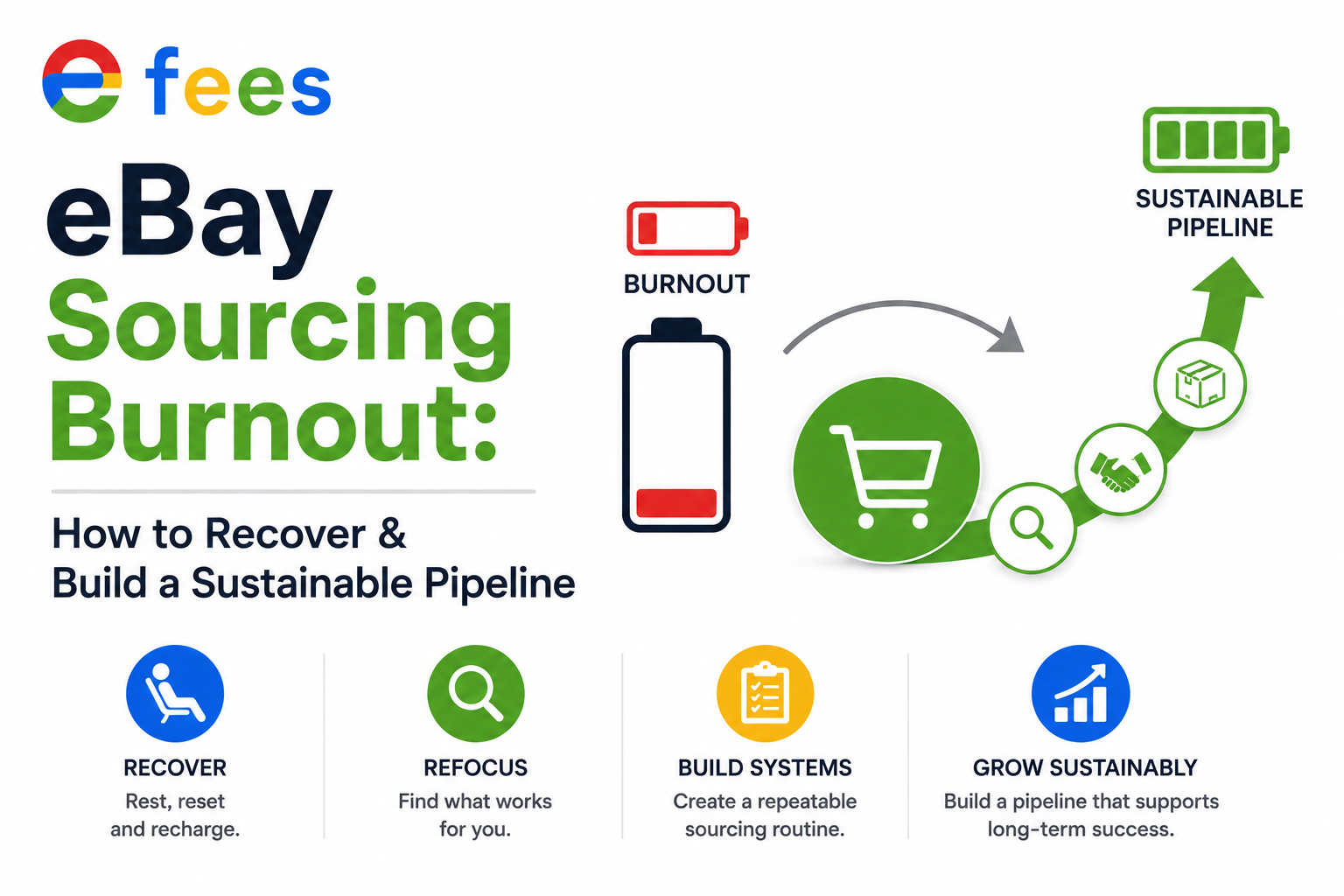
The Sourcing Burnout Nobody Talks About. And Why Your Side Hustle Feels Like a Second Job You Can't Quit.
There's a specific kind of tired that hits eBay resellers. It's not from your day job. It's from walking into your third thrift store on a Saturday and feeling absolutely nothing. Not excitement. Not hope. Just numbness. Sourcing burnout is real, it's not a personal failure, and the "hustle harder" crowd won't tell you that your effective hourly rate has probably dropped below minimum wage. Here's how to actually recover: take the break, run the honest numbers, set non-negotiable boundaries, and rebuild a sourcing pipeline that doesn't require you to be miserable.
Calculate Your eBay Selling Fees
Our free eBay Fee Calculator automatically calculates final value fees, promoted listing fees, international fees, regulatory fees, store subscription discounts, and different category-specific fee structures. See your estimated eBay fees, profit, and profit margin in seconds before you list.
Open Free eBay CalculatorSourcing Burnout: A Guide to Recognition, Recovery, and Sustainable Reselling
There is a specific kind of tired that hits eBay resellers. It is not the tired of a long day at your actual job. It is not the tired of staying up too late. It is the tired that comes from walking into your third thrift store of a Saturday morning, staring at the same racks of fast fashion and chipped mugs, and feeling absolutely nothing. Not excitement. Not hope. Not even disappointment. Just a flat, gray numbness that makes you wonder why you are holding a scanner in your hand instead of doing literally anything else.
This is sourcing burnout. And if you are feeling it right now, you are not alone. You are also not broken. The reselling content machine is simply very good at making you feel like you are.
This guide provides a structured, data-driven analysis of sourcing burnout, its underlying causes, and practical strategies for recovery and sustainable reselling practices.
Key Takeaways
- Sourcing burnout is an occupational hazard, not a personal failure. The reselling culture rewards constant motion, but human beings require rest. Recognizing burnout is the first step to recovery.
- The dopamine loop drives unsustainable behavior. The anticipation of finding something valuable is what drives the hunt, not the actual outcome. This neurological mechanism keeps you sourcing long after it is rational.
- Burnout is expensive. Calculate your true effective hourly rate during burnout. It is often below minimum wage. The solution is not to source more—it is to change what and how you source.
- Take a complete sourcing break. Two weeks minimum. Three is better. No sourcing, no browsing, no "just checking." Use the time to list what you already have and rebuild trust with yourself.
- Audit your numbers honestly. Log every sourcing trip, every item, every sale, every cost. Face the reality of your true hourly rate. This breaks the spell of compulsive sourcing.
- Rebuild sustainably. Diversify your sourcing channels so you are not dependent on one exhausting activity. Source seasonally to reduce pressure. Set hard boundaries on trips, budgets, and inventory accumulation.
- Redefine success. Success can be steady sales and your weekends back. If your definition of success requires you to be burned out, your definition is wrong.
- Rest is not laziness. Boundaries are not weakness. A business that requires you to be miserable is a trap, not a success.
1. The Reselling Content Machine: Why Burnout Is an Occupational Hazard
Everywhere you look in the reselling space, someone is posting a haul video. Someone is showing off their $400 estate sale score. Someone is talking about how they hit five stores before 9 AM and still made it to the post office by noon. The algorithm rewards constant motion. The Facebook groups reward big finds. The entire culture of reselling is built on the idea that if you are not sourcing, you are not working—that every weekend not spent digging through bins is a weekend wasted, and that rest is something other people do.
But here is what those videos do not show. They do not show the reseller who has not taken a weekend off in eight months. They do not show the garage so full of unlisted inventory that there is no room for a car. They do not show the marriages strained by "just one more store" or the friendships that withered because every conversation somehow turned into a discussion about comps and shipping rates. They do not show the 3 AM panic about whether that pallet was actually a good buy or just expensive garbage that will sit in a corner for a year. They do not show the shame spiral of looking at your death pile and feeling so overwhelmed that you go sourcing again just to feel something other than dread.
Sourcing burnout is not just being tired. It is when the activity that used to feel like treasure hunting starts feeling like an obligation. When you find yourself buying things you do not even like because you feel like you have to come home with something. When the high of a good find lasts approximately twelve minutes before you are already anxious about the next trip. When your inventory room is full but your energy account is overdrawn.
2. The Dopamine Loop: Why Reselling Traps You
Reselling is uniquely designed to trap you in a dopamine loop. The hunt is the reward. Listing is the work. Selling is the validation. So when listing feels hard or sales are slow, your brain tells you the solution is more sourcing—more hunting, more dopamine. Never mind that you already have four bins of stuff you have not photographed. Never mind that your bank account is strained from buying inventory faster than you can sell it. The hunt feels productive even when it is actually making the problem worse.
The Neurological Reality:
Dopamine is not released when you find something valuable. It is released during the anticipation of finding something valuable. This is why the first hour of sourcing is often the most exciting and why the excitement fades as you continue. The anticipation drives the behavior, not the actual outcome. This neurological mechanism is evolutionarily designed to keep us searching for food and resources. In reselling, it keeps us sourcing long after it is economically rational to do so.
The Shame Spiral:
When the hunt no longer provides dopamine, many resellers feel shame. They think they have lost their edge, their passion, their ability to spot value. This shame drives them to source more aggressively to prove that they still have it. This is the opposite of what is needed. The brain that is exhausted cannot spot value accurately. It buys junk. It overpays. It makes decisions based on scarcity and anxiety rather than strategy. This is how death piles grow. Not through bad sourcing strategies, but through a brain that is too tired to apply good sourcing strategies.
3. The Financial Reality: What Burnout Costs
Most resellers who are burned out discover, when they finally run the numbers, that their effective hourly rate from sourcing has dropped below minimum wage. They have been running on the fumes of past success, buying inventory out of habit rather than strategy.
The True Cost of Sourcing:
Calculate everything. Gas. Time driving. Time in stores. Time listing. Time shipping. The emotional cost of dealing with returns on items you bought while burned out and did not inspect properly. The cost of storage space for items that will never sell. The opportunity cost of time not spent on higher-margin activities.
When resellers calculate their true effective hourly rate during burnout, they often find they are making $5–$10 per hour—or sometimes losing money outright. The numbers do not lie. And facing them is what breaks the spell.
4. Recovery Strategy One: The Sourcing Break
First, you have to stop. Not forever. Not even for a month. But you have to take a sourcing break that is long enough for your nervous system to remember what rest feels like. Two weeks minimum. Three is better. During that time, you are not allowed to enter a thrift store. You are not allowed to browse liquidation websites at midnight. You are not allowed to "just check" that estate sale down the street. The break is the break.
The Psychological Challenge:
This break will feel wrong. Your brain will scream at you that you are missing deals, that other resellers are getting ahead, that the algorithm will punish you for not listing new inventory. Let it scream. The algorithm does not care about your mental health. You have to.
What to Do During the Break:
During the break, your only job is to list what you already have. Not all of it—that would be another form of burnout. But some of it. An hour a day. Two items. The goal is not to clear the death pile. The goal is to prove to yourself that you can make money from what you already own, that your business is not dependent on a constant influx of new stuff, that the inventory you have already paid for is enough. This is psychological repair work, not logistics. You are rebuilding trust with yourself.
5. Recovery Strategy Two: Honest Number Analysis
Next, you need to look at your numbers honestly—not your gross sales, but your actual profit per hour of sourcing.
The Audit Process:
Create a spreadsheet. For each sourcing trip in the past month, log: the time spent (driving plus shopping), the money spent, the items purchased, the date each item listed, the date each item sold, the final sale price, the fees paid, the shipping cost, and the profit. This will reveal your true effective hourly rate and identify which sourcing trips were profitable and which were not.
What to Look For:
If your effective hourly rate from sourcing is below $15 per hour, you have a problem. You are not running a business. You are running a hobby that costs you time you could spend on something more productive. The solution is not to source more to make up the difference. The solution is to change what you source and how you source it.
6. Recovery Strategy Three: Sustainable Sourcing Systems
Once you see the numbers, you can rebuild your pipeline sustainably. Sustainable means diversified, seasonal, and bounded.
Diversified Sourcing:
You are not dependent on one sourcing channel. If your entire business is built on thrifting every weekend, you are going to burn out because thrifting is physically exhausting and geographically limited. Add a wholesale relationship for baseline inventory. Add estate sales for high-margin pieces. Add online arbitrage for days when you do not want to leave the house. When one channel feels stale, you rotate to another. The variety itself is protective. You are not doing the same exhausting thing every single week.
Seasonal Sourcing:
You stop fighting the calendar. Summer is slow for most resellers. Instead of panicking and sourcing more to compensate, use that season to buy off-season inventory at clearance prices. Winter coats in July. Holiday decor in January. Pool equipment in October. This requires patience and storage space, but it removes the pressure to constantly be finding fresh inventory. You are buying ahead, not chasing the moment. That mental shift alone reduces anxiety significantly.
Bounded Sourcing:
You set actual limits and you treat them as non-negotiable. One sourcing trip per week. A strict budget per trip. A maximum number of items you can bring home before you have to list what you already have. These are not suggestions. They are guardrails. The reason most resellers burn out is that they have no guardrails. They source until they are tired, spend until they are anxious, and accumulate until they are overwhelmed. Boundaries are what make this a business instead of a compulsion.
7. Redefining Success
You also need to redefine what success looks like. The reselling content world has convinced people that success is a full garage, a six-figure revenue number, and a lifestyle of constant hustle. But success can also be a hundred listings, steady sales, and your weekends back. It can be making enough to cover your bills without making yourself sick. It can be a business that fits your life instead of consuming it.
The Cost of a Faulty Definition:
If your definition of success requires you to be burned out, your definition is wrong. And it is not eBay's fault. It is a choice you are making, which means it is a choice you can unmake.
Goal Setting for Sustainability:
Set goals that are process-oriented rather than outcome-oriented. "Source for three hours this week" is a process goal. "Find ten items with a potential profit of $20 or more" is a process goal. "Make $1,000 this month" is an outcome goal. Outcome goals are fine, but they should be secondary to process goals. Process goals give you control. Outcome goals depend on factors outside your control.
8. Dealing with Guilt
The hardest part of recovery is dealing with the guilt. Resellers are entrepreneurs, and entrepreneurs are taught that rest is laziness. That if you are not growing, you are dying. That every moment not spent building is a moment wasted.
The Lie:
This is a lie sold to you by people who profit from your exhaustion. Rest is not laziness. Boundaries are not weakness. A business that requires you to be miserable is not a good business. It is a trap with a spreadsheet.
Accountability:
Tell someone you trust about your break. A partner, a friend, a fellow reseller. Ask them to hold you accountable. When the urge to source hits—and it will—you have someone who can remind you why you are taking the break.
9. The Bottom Line
If you are in the middle of burnout right now, hear this. You do not have to quit reselling. You do not have to dramatically downsize. You do not have to post a goodbye video and sell your shelving on Facebook Marketplace. You just have to stop treating your body and your brain like they are renewable resources. They are not. They are inventory too. And they have carrying costs.
Take the break. Run the numbers. Set the boundaries. Diversify your channels. Buy seasonally. And most importantly, give yourself permission to be a human being who sells things on the internet, not a selling machine that occasionally remembers to be human.
Your business will still be there when you come back. The thrift stores are not going anywhere. The estate sales will keep happening. The inventory will still exist. But you, in your current state, will not exist forever if you keep running at this pace.
Q&A:
Question: How do I know if I am experiencing sourcing burnout or just a temporary slump?
Short answer: Burnout is characterized by a persistent flatness or numbness toward sourcing, a feeling of obligation rather than excitement, and buying inventory out of habit rather than strategy. A temporary slump is usually tied to a specific event—a bad sourcing trip, a slow sales week—and passes with a few days of rest. Burnout persists even after rest.
Question: How long should my sourcing break be?
Short answer: Two weeks minimum. Three is better. During this time, you are not allowed to enter a thrift store, browse liquidation websites, or "just check" estate sales. The break must be complete to allow your nervous system to reset.
Question: What should I do during the sourcing break?
Short answer: List what you already have. Not all of it, but some of it. An hour a day. Two items. The goal is to prove to yourself that you can make money from what you already own and to rebuild trust with yourself.
Question: What numbers should I audit during recovery?
Short answer: For each sourcing trip in the past month, calculate the time spent (driving plus shopping), the money spent, the items purchased, the date each item listed, the date each item sold, the final sale price, the fees paid, the shipping cost, and the profit. This reveals your true effective hourly rate.
Question: What is the most common mistake resellers make when burned out?
Short answer: Sourcing more to compensate for the burnout. The hunt feels productive even when it is making the problem worse. The correct response is to stop sourcing entirely, audit your numbers, and rebuild your pipeline sustainably.

eFee Editorial Team
The eFee Editorial Team publishes research-driven content to help eBay sellers better understand marketplace fees, pricing strategies, shipping costs and profitability. Our articles are regularly updated to reflect the latest eBay fee structures and seller best practices.
Reviewed periodically to reflect the latest eBay marketplace fee updates.
Was this article helpful?
Your feedback helps us improve future articles.