
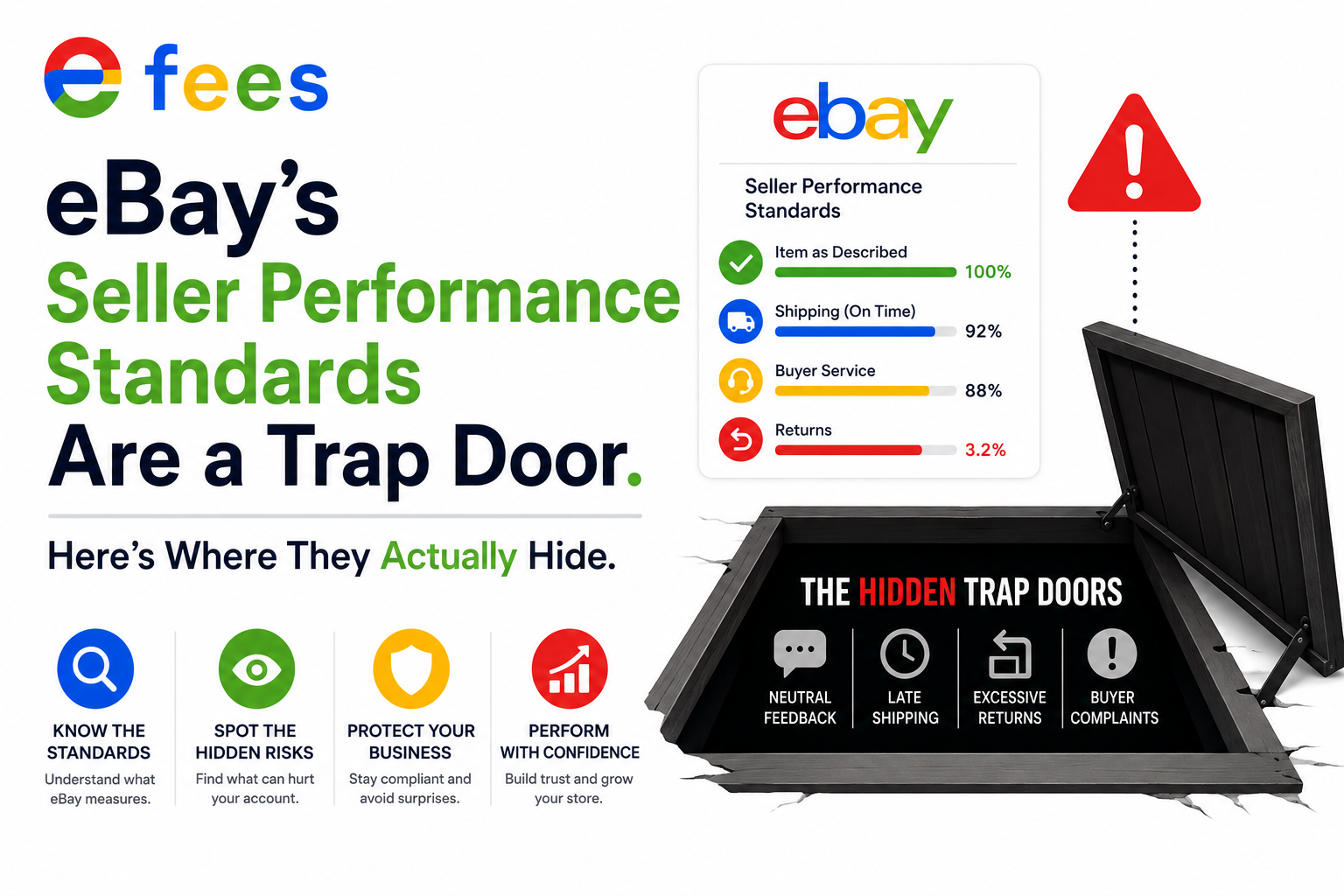
eBay's Seller Performance Standards Are a Trap Door. Here's Where They Actually Hide.
Most resellers don't think about their seller level until the yellow banner appears. eBay's performance standards aren't just badges—they're a trap door. A 0.5% defect rate sounds small, but it means one bad transaction out of 200 can cost you thousands in fees and search visibility. Here's the practical guide to staying Above Standard that eBay's dry documentation won't give you.
Calculate Your eBay Selling Fees
Our free eBay Fee Calculator automatically calculates final value fees, promoted listing fees, international fees, regulatory fees, store subscription discounts, and different category-specific fee structures. See your estimated eBay fees, profit, and profit margin in seconds before you list.
Open Free eBay CalculatoreBay Seller Performance Standards: A Guide to Metrics, Margins, and Recovery
Most resellers do not think about their seller level until it is too late. You are cruising along, sales are decent, feedback is mostly positive, and then one morning you open Seller Hub and see a yellow banner: "Your seller level is Below Standard." Suddenly your fees went up. Your listings are buried. And you are staring at a thirty-day recovery window, wondering how two bad transactions out of three hundred tanked your entire business.
eBay's official documentation on performance standards is dense and impenetrable, full of percentages and policy references with little practical context. This guide provides a structured, data-driven breakdown of what the performance standards actually mean, how thin your margin for error really is, and what to do when you feel yourself sliding toward the cliff.
Key Takeaways
- The defect rate threshold is 0.5%. That means one defect per 200 transactions, or five per 1,000. Defects include negative feedback, neutral feedback, and lost "item not as described" or "item not received" cases.
- The late shipment rate threshold is 3%. If your handling time is one day, ship and upload tracking within one day. A carrier scan on day two counts as late.
- The tracking upload rate threshold is 95%. Ship everything with tracking and upload the number immediately. Stamped envelopes without tracking count against you.
- Cases closed without seller resolution have a 0.3% threshold. One case per 300 transactions is your entire budget. eBay stepping in and deciding against you is a strike.
- Below Standard status triggers a 6% fee surcharge and suppresses your listings in search. Recovery requires perfect metrics for at least thirty days.
- Top Rated status provides a 10% fee discount and search visibility, but requires one-day handling and 30-day returns. Only chase it if you can consistently deliver.
- Check your Seller Dashboard weekly. Not monthly. Weekly. If any metric is within half a percent of the threshold, you have a problem that needs fixing this week, not next month.
1. The Three Seller Levels
eBay has three seller levels: Top Rated, Above Standard, and Below Standard. Most sellers assume they are safe if they are not suspended. They are wrong. The gap between Above Standard and Below Standard is tiny, and the gap between Above Standard and Top Rated is where your profit actually lives.
To stay Above Standard, eBay tracks four main metrics over a rolling twelve-month period: defect rate, late shipment rate, tracking upload rate, and cases closed without seller resolution. Each has a specific threshold. Miss any of them and you drop. It does not matter if your sales are up. It does not matter if your buyers love you in messages. One metric slips and eBay treats you like a liability.
2. Defect Rate: The Brutal Math
The defect rate is the metric that catches resellers most often. eBay defines a defect as any transaction where you receive negative or neutral feedback, an "item not as described" case that you lose, or an "item not received" case that you lose. The threshold for Above Standard is 0.5%. That sounds small. It is small. It is brutally small.
The Real Numbers:
If you have sold 200 items in the last year, you are allowed exactly one defect. One neutral feedback. One "item not as described" case that eBay sides with the buyer on. One lost dispute. That is your entire budget. Your second defect puts you at 1%, which is Below Standard.
If you have sold 1,000 items, your budget is five defects. That sounds like more breathing room until you realize that a single bad weekend can generate multiple defects. A batch of items sourced from a liquidation pallet with hidden damage. A postal delay during a holiday weekend triggering four "item not received" cases. A difficult buyer who opens cases on three separate orders. Defects compound quickly, and once they are on your record, they remain for twelve months.
3. Late Shipment Rate: The Unforgiving Clock
The late shipment rate threshold is 3%. This metric is straightforward but equally punishing for resellers who are disorganized. If your handling time is one business day and you ship on day two, that is late. If you mark something shipped but the carrier does not scan it until the next day, eBay counts that as late. If you forget to upload tracking within your handling window, it is late. Three late shipments out of 100 sales and you are in trouble.
Why Resellers Get Hit:
Resellers get hit here because their business is chaotic by nature. You are sourcing on Saturday, photographing Sunday, listing Monday, and shipping Tuesday through Friday. If you sell something Monday night and your handling time is one day, that item needs to be scanned by Tuesday night—not dropped at the post office, but scanned. If you drop it Tuesday evening and the carrier scans it Wednesday morning, that is a late shipment. The math is unforgiving.
4. Tracking Upload Rate: The Simple One You Can't Afford to Miss
The tracking upload rate threshold is 95%. This metric should be easy, but resellers mess it up constantly. If you ship something without tracking, or if you forget to upload the tracking number to eBay, or if you use a carrier that eBay does not recognize, it counts against you. Selling a $15 item and shipping it via stamped envelope to save $2? That just cost you tracking compliance. Do that on 5% of your orders and you are Below Standard.
5. Cases Closed Without Seller Resolution: The Zero-Tolerance Metric
The threshold for cases closed without seller resolution is 0.3%. This means a buyer opened a case against you, eBay had to step in and make a decision, and eBay decided against you. It does not matter if the buyer was lying. It does not matter if the case was frivolous. If eBay closes it in the buyer's favor, it is a strike. At 0.3%, your budget is microscopic. Sell 300 items and you get exactly zero of these cases. One case closed without resolution and you are already over the limit.
6. What Happens When You Drop Below Standard
When you drop Below Standard, the consequences are severe and immediate. eBay imposes a 6% surcharge on your final value fees—the standard penalty for Below Standard status, which can combine with other surcharges in some cases. If you are paying 13.6% in a category, you are now paying 19.6% or more. On a $50 sale, that is an extra $3. Across 100 sales, that is $300. It is a tax on being disorganized.
Worse, your listings get suppressed. eBay's search algorithm deprioritizes Below Standard sellers. Your impressions drop. Your sales drop. And because your sales drop, you have fewer transactions to dilute your defect rate, which makes it harder to climb back out. It is a downward spiral.
The Top Rated Advantage:
If you are Top Rated, you receive a 10% discount on final value fees. Your listings receive a boost in search. You get priority customer support. The gap between Top Rated and Below Standard is not just about pride. It is about thousands of dollars a year in fee differences and visibility that you cannot buy back with Promoted Listings.
7. How to Stay Out of Trouble
Treat Handling Time as a Hard Deadline:
If your current handling time is one day and you are consistently cutting it close, change it to two days. Buyers prefer faster shipping, but a two-day handling time that you actually meet is infinitely better than a one-day handling time that you miss. eBay does not reward ambition. It rewards compliance.
Upload Tracking Immediately:
Upload tracking the moment you have it—not when you get home from the post office, not after dinner. The second the carrier hands you a receipt or scans the label, that number goes into eBay. If you use eBay's shipping labels, this happens automatically. If you ship outside eBay's system, use a tool that auto-uploads tracking or build the thirty seconds into your workflow. That thirty seconds is what separates Above Standard from a fee surcharge.
Be Brutally Honest in Listings:
For the defect rate, the only real defense is brutal honesty in your listings. Resellers hate this because it feels like admitting weakness. But a buyer who knows exactly what they are getting does not open "item not as described" cases. Photograph flaws from three angles. Describe them in specific, unemotional language: "Small pull on left sleeve, approximately half inch, visible in photo 8." Not "minor wear." Not "good condition." Specificity is your insurance policy. Most "item not as described" cases come from buyers who feel surprised. Eliminate surprise.
Solve Problems Before They Become Cases:
If a buyer messages you with a problem, solve it before they open a case. Once a case is opened, your control drops significantly. eBay's system encourages buyers to escalate. If you refund voluntarily, it does not count as a defect. If eBay forces the refund after a case, it might. Eat the loss on the edge cases. A $15 refund is cheaper than a defect that stays on your record for a year.
Use Tracking on Everything:
For the "item not received" metric, use tracking on everything. Yes, it costs more than a stamp. Build it into your price. If an item is genuinely lost in the mail, refund immediately and file a claim with the carrier. Do not fight the buyer. Do not make them wait while you investigate. The defect is what matters, not the $20 item.
8. How to Recover If You Are Already Below Standard
Recovery is possible, but it requires discipline. You need to accumulate clean transactions to dilute your defect rate. This means listing items that sell quickly and ship without drama. It means avoiding high-risk inventory like fragile electronics or clothing with subjective condition issues. It means saying no to problem buyers even if it costs you a sale. For thirty days, your only goal is perfect metrics—not profit maximization, not growth. Perfect metrics.
Check Your Seller Dashboard Weekly:
Not monthly. Weekly. The dashboard shows your rolling twelve-month metrics and tells you exactly where you stand relative to each threshold. If your late shipment rate is creeping toward 2%, you have a problem before it becomes a crisis. If you have two defects and you are approaching the 200-transaction mark where a third one would push you over, you need to be flawless until you cross that threshold.
Top Rated Status:
Top Rated status requires all the Above Standard metrics plus a 0.5% or lower late shipment rate and tracking on 95% of orders. However, it also requires you to offer 30-day returns and one-day handling. Those are commitments. Do not chase Top Rated if you cannot actually deliver one-day handling consistently. It is better to be solidly Above Standard than to flirt with Top Rated, miss it, and slip into Below Standard because you were overextended.
9. The Hard Truth
eBay's performance standards are designed to filter out unreliable sellers. They are not designed to be fair. They are designed to protect buyers and, by extension, eBay's brand. A single neutral feedback from a buyer who was unreasonable counts exactly the same as a legitimate complaint. The system does not care about your side of the story. It cares about the percentage.
You have to be better than the system requires—not by much, but by enough that a bad week or a difficult buyer does not push you over the edge. You need buffer. You need processes that are boring but bulletproof. And you need to check your dashboard before eBay checks it for you.
Q&A:
Question: What is the defect rate threshold for Above Standard status?
Short answer: The threshold is 0.5%. If you have sold 200 items in the last year, you are allowed exactly one defect. A second defect puts you at 1%, which is Below Standard. For 1,000 sales, your budget is five defects.
Question: What counts as a defect?
Short answer: Negative or neutral feedback, an "item not as described" case that you lose, or an "item not received" case that you lose. Voluntary refunds before a case is opened do not count as defects.
Question: What is the late shipment rate threshold?
Short answer: The threshold is 3%. Three late shipments out of 100 sales puts you at risk of dropping Below Standard. Late is defined as shipping after your stated handling time or failing to upload tracking within that window.
Question: What happens if I drop Below Standard?
Short answer: eBay imposes a 6% surcharge on your final value fees. Your listings are suppressed in search results. Your sales drop, which makes it harder to dilute your defect rate and recover. It is a downward spiral.
Question: How do I recover from Below Standard status?
Short answer: Accumulate clean transactions to dilute your defect rate. List items that sell quickly and ship without drama. Avoid high-risk inventory. Say no to problem buyers. For thirty days, your only goal is perfect metrics. Check your Seller Dashboard weekly and address any metric that is approaching a threshold.

eFee Editorial Team
The eFee Editorial Team publishes research-driven content to help eBay sellers better understand marketplace fees, pricing strategies, shipping costs and profitability. Our articles are regularly updated to reflect the latest eBay fee structures and seller best practices.
Reviewed periodically to reflect the latest eBay marketplace fee updates.
Was this article helpful?
Your feedback helps us improve future articles.