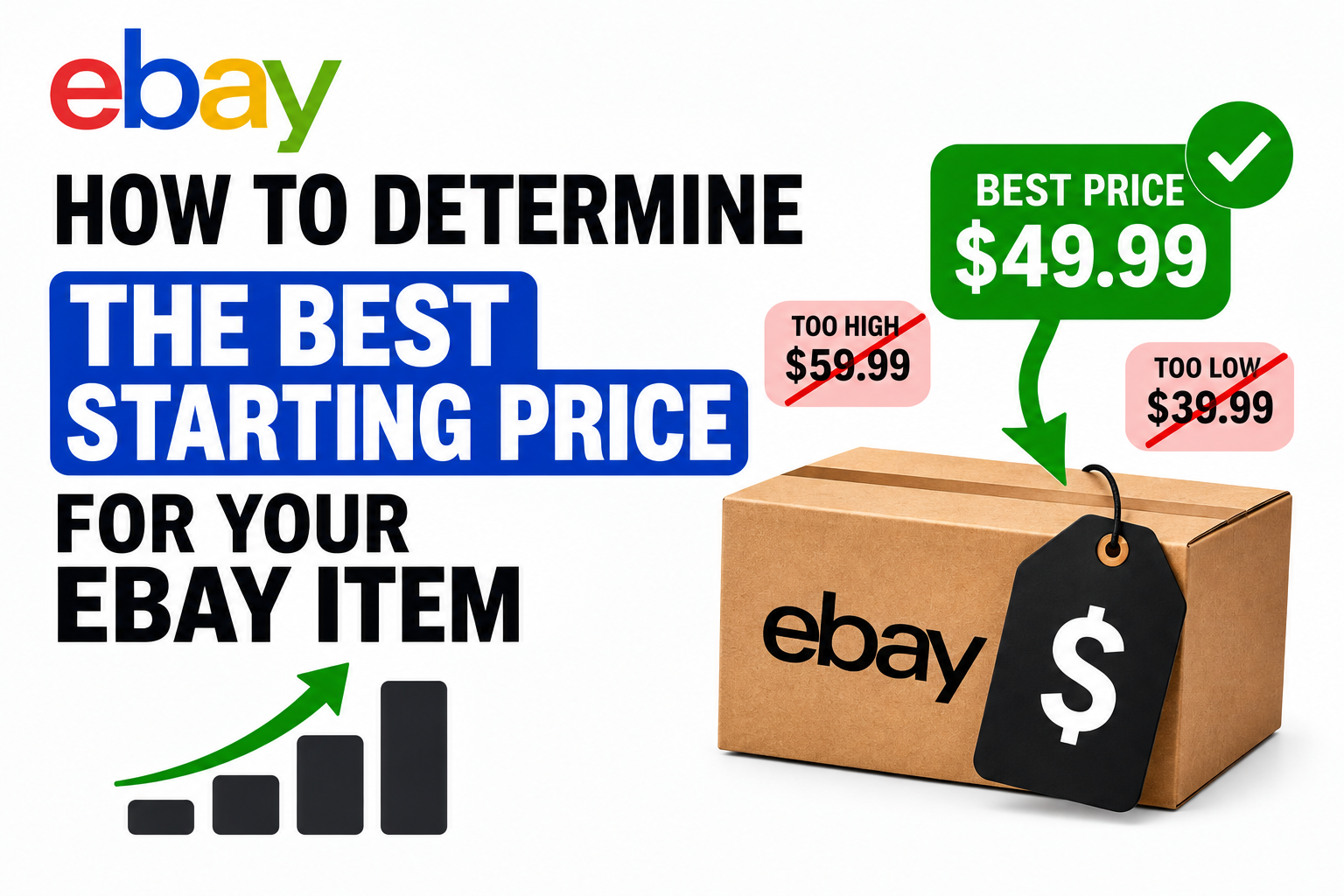
How to Determine the Best Starting Price for Your eBay Item?
Most sellers price off what similar items are asking — not what they actually sold for. Here's the real method: sold data, fee math, and the right strategy for auctions vs. fixed-price listings.
Calculate Your eBay Selling Fees
Our free eBay Fee Calculator automatically calculates final value fees, promoted listing fees, international fees, regulatory fees, store subscription discounts, and different category-specific fee structures. See your estimated eBay fees, profit, and profit margin in seconds before you list.
Open Free eBay CalculatorHow to Determine the Best Starting Price for Your eBay Item: Pricing Strategy
Pricing an item on eBay is one of the most consequential decisions a seller makes. Set the price too high, and your listing will sit unsold while competitors move their inventory. Set it too low, and you leave money on the table or, worse, sell at a loss after fees and shipping are factored in. The difference between a successful sale and a stagnant listing often comes down to whether you priced based on empirical market data or speculative asking prices.
This guide provides a structured, evidence-based methodology for determining the optimal starting price for your eBay listing, covering market research, condition adjustments, fee calculations, and format-specific strategies.
Key Takeaways
- Price against sold listings, not active ones. Sold data reflects what buyers have actually paid; active listings reflect seller hopes. This is the single most important pricing principle.
- Adjust for condition, completeness, and listing quality. A used item with wear belongs near the bottom of the sold range; a complete, like-new item can sit near the top. High-quality photos and descriptions can nudge your price upward within the same category.
- Run the fee calculation before setting your price. eBay's final value fee is approximately 13.6% of the total sale amount plus $0.40 per order. Knowing your net proceeds before listing prevents unpleasant surprises.
- Use different strategies for auctions and fixed-price listings. Auctions benefit from low starting bids to attract activity; fixed-price listings should match or slightly undercut the median sold price.
- Consider free shipping strategically. Build shipping costs into the item price to improve search visibility and conversion, but do not eat the cost—fold it into your list price.
- Avoid the common pricing pitfalls. Do not price off active listings, forget fees, start auctions too high, treat used items as new, or ignore shipping presentation. Each of these errors undermines profitability and extends time to sale.
1. The Pricing Fallacy: Active Listings vs. Sold Data
The most common pricing mistake on eBay is benchmarking against active listings rather than completed sales. Active listings represent seller aspirations—prices that sellers hope to achieve. A significant portion of these listings sit untouched for months at numbers that buyers have consistently rejected. Pricing based on these figures is pricing based on hope, not market reality.
The Empirical Method:
To determine true market value, search for your item on eBay and apply the Sold Items filter. This shows completed transactions from approximately the past one to three months, providing a clear picture of what buyers have actually paid. Adding the Completed Items filter is also useful, as it shows both sold and unsold listings, giving you insight into which prices failed to attract buyers.
Once you have filtered to sold listings, sort by most recent to capture current market conditions rather than outdated data. Pay attention not just to the sale price, but to whether shipping was free or charged separately, as this affects the total cost to the buyer and should inform your own pricing strategy.
The Data Set: A robust pricing analysis should include at least ten to twenty comparable sold listings. A smaller sample size may be skewed by outlier transactions, while a larger sample provides statistical confidence in the price range. If your item is rare and only a few have sold recently, expand your search to include similar items or consider whether the limited data justifies a premium or discount.
2. Condition Assessment: Placing Your Item Within the Market Range
Once you have established a sold-price range—for example, between $35 and $55—you still need to position your specific item within that spectrum. This placement depends on three primary factors: condition, completeness, and listing quality.
Condition Grading:
A used item with visible wear, missing components, or cosmetic damage belongs near the bottom of the sold-price range. Buyers in this segment are typically price-sensitive and willing to accept imperfections in exchange for a lower cost. An item in new or like-new condition, with original packaging and all accessories and manuals intact, can reasonably sit near the top of the range. Collectors and condition-conscious buyers are willing to pay a premium for completeness.
Completeness and Accessories:
Items that include all original accessories, documentation, and packaging command higher prices than loose items sold without these components. This is particularly true in categories like electronics, collectibles, and photography equipment. If your item is missing any original components, deduct accordingly from the median sold price.
Listing Quality as a Value Driver:
Buyers consistently pay more for listings that appear trustworthy and professional. Well-lit, multiple-angle photographs, accurate descriptions, and clear condition disclosures signal reliability and reduce buyer anxiety. A listing with subpar photos or vague descriptions, even for an identical item, will typically sell for less or take significantly longer to move. Investing time in quality listing presentation can meaningfully nudge your price upward within the same product category.
3. Fee Mathematics: Calculating Your True Net Proceeds
This is where many sellers make their most costly error: they identify a market-compatible price, list the item, and only realize afterward that eBay's fees consumed most of their margin. The fee calculation must be performed before you set your price, not after.
The Fee Formula:
Your list price must account for four components: item cost, shipping cost, eBay fees, and your desired profit margin. The formula can be expressed as:
List price = item cost + shipping cost + eBay fees + desired profit
For most categories, eBay's final value fee is approximately 13.6% of your total sale amount, which includes the item price plus shipping. A flat $0.40 per order is also deducted. This means a $50 sale is not $50 in your pocket. After fees, the net proceeds are approximately $42.80 before you have paid for the item itself or packaging materials.
The Break-Even Analysis:
If your research indicates the item typically sells for $50, and your combined costs plus fees already total $45, your net profit is only $5. That may be acceptable for a high-volume item with minimal handling time, or it may be insufficient for a unique item requiring significant effort to list and ship. Either way, knowing this figure before listing allows you to make an informed decision rather than discovering a disappointing margin after the sale.
Fee Calculation Tools: To simplify the math, use the eBay Fees Calculator by efeecalculator, which allows you to plug in your price and see exactly what you are left with after fees. This tool is particularly useful for comparing different pricing scenarios across multiple listings.
4. Format-Specific Pricing Strategies: Auctions vs. Fixed Price
Auctions and fixed-price listings require fundamentally different strategies. Treating them as interchangeable is a common source of suboptimal outcomes.
Auction Pricing Strategy:
With an auction format, starting low—typically between $0.99 and $9.99—serves a specific purpose: it attracts the first bid, which triggers eBay's search algorithm to favor listings with active bidding activity. A low opening price is more likely to generate that initial momentum. This strategy works well for items with real competitive demand: collectibles, rare finds, vintage electronics, and any item where multiple buyers are likely to bid against each other.
The auction format carries inherent risk, however. For common items with ample supply and limited demand, a low starting price with insufficient competition simply results in a low final sale price. Auctions are best reserved for items where competitive bidding is likely to drive the price above a fixed-price median.
Fixed-Price Pricing Strategy:
With a fixed-price listing, buyers are comparing your number directly against all other active listings. Pricing above the going rate, even slightly, tends to reduce views, as eBay's search algorithm favors listings that appear competitive and buyers naturally gravitate toward the lowest price for identical items.
The optimal fixed-price strategy is to match or slightly undercut the median of the most recent sold comparables. Undercutting by a small margin—such as one or two percent—can improve search visibility and conversion rates without sacrificing significant margin. However, undercutting too aggressively may signal desperation or poor item quality, potentially reducing buyer confidence.
The choice between auction and fixed-price formats requires fundamentally different strategies, and treating them as interchangeable is a common source of suboptimal outcomes. With an auction format, starting low—typically under ten dollars—serves a specific purpose: it attracts the first bid, which triggers eBay's search algorithm to favor listings with active bidding activity. This strategy works best for collectibles, rare items, and high-demand products where multiple buyers are likely to compete against each other, driving the final price above a typical fixed-price median. The auction format carries inherent risk, however, as common items with ample supply and limited demand may sell for disappointingly low amounts if bidding activity is thin. With a fixed-price listing, by contrast, the optimal strategy is to match or slightly undercut the median of the most recent sold comparables. This approach works best for common items, commodity goods, and buyers seeking immediate purchase without the uncertainty of an auction. Undercutting by a small margin—such as one or two percent—can improve search visibility and conversion rates without sacrificing significant margin, while pricing above the going rate, even slightly, tends to reduce views as eBay's search algorithm favors listings that appear competitive and buyers naturally gravitate toward the lowest price for identical items.
5. Shipping Presentation: The Free Shipping Consideration
Listings with shipping costs built into the item price—commonly marketed as "free shipping"—tend to perform better than those with separate shipping charges. eBay's search algorithm favors these listings, and buyers consistently prefer a single, clean number over a lower item price paired with a shipping charge that feels like an add-on.
The Free Shipping Strategy:
If you choose to offer free shipping, fold your actual shipping cost into the item price rather than eating it as a loss. Calculate your shipping expense based on the item's weight, dimensions, and destination zone, then add that amount to your list price. This approach maintains your margin while presenting a more attractive total to the buyer.
The Fee Implication: Keep in mind that eBay's final value fee applies to the total sale amount, including shipping. Whether you charge shipping separately or build it into the price, the fee is calculated on the same total. The decision to offer free shipping changes how the price is displayed, not how much you owe in fees.
6. Common Pricing Pitfalls: What to Avoid
Several recurring errors consistently undermine seller profitability. Recognizing and avoiding these pitfalls is essential for consistent success.
Pricing off active listings: This is the single most common and costly mistake. Active listings are unverified seller aspirations, not market data. Always use sold listings as your primary reference.
Forgetting eBay's fees: Setting a price based on market comparables without deducting fees results in a net figure that is often significantly lower than anticipated. Run the fee calculation before, not after, listing.
Starting an auction too high: A high opening bid suppresses bidding activity before it ever starts, reducing momentum and final sale price. Low starting bids attract activity, which drives algorithmic visibility.
Treating used items like new items: Sold data consistently separates these categories. A used item with wear belongs near the bottom of the sold range, not the top, regardless of how well it has been maintained.
Ignoring shipping presentation: Even when the total cost to the buyer is identical, how shipping is displayed affects buyer perception and conversion rates. Free shipping listings generally outperform those with separate charges.
FAQ:
How do I find out what an item has actually sold for on eBay?
Search the item, then filter by "Sold Items." This shows completed sales from approximately the past one to three months, providing a much more accurate guide than what other sellers are currently asking.
Should I price my item based on active listings?
Not reliably. Active listings reflect what sellers hope to get, not what buyers are actually paying. Sold listings are the number that matters for accurate pricing.
What is a reasonable starting bid for an auction?
Most experienced sellers start between $0.99 and $9.99, as a low opening bid tends to attract that first round of bidding activity—which matters because eBay's search algorithm rewards listings that already have bids.
How do eBay's fees factor into my price?
For most categories, expect approximately 13.6% of your total sale amount (item price plus shipping), plus a flat $0.40 per order. It is easy to price an item that appears profitable but is not once fees are deducted, so run the calculation before listing.
Does free shipping actually help?
Generally, yes. Free shipping listings tend to rank better in search and convert better, since buyers prefer a single, transparent price. Just remember that eBay's fee still applies to the full amount either way.
How close should my price be to similar sold items?
Aim for the median, or just under it, unless your item has a clear advantage such as better condition, original packaging, or extra accessories. Pricing meaningfully above that median without a justification will likely result in fewer views and a longer time to sell.

eFee Editorial Team
The eFee Editorial Team publishes research-driven content to help eBay sellers better understand marketplace fees, pricing strategies, shipping costs and profitability. Our articles are regularly updated to reflect the latest eBay fee structures and seller best practices.
Reviewed periodically to reflect the latest eBay marketplace fee updates.
Was this article helpful?
Your feedback helps us improve future articles.