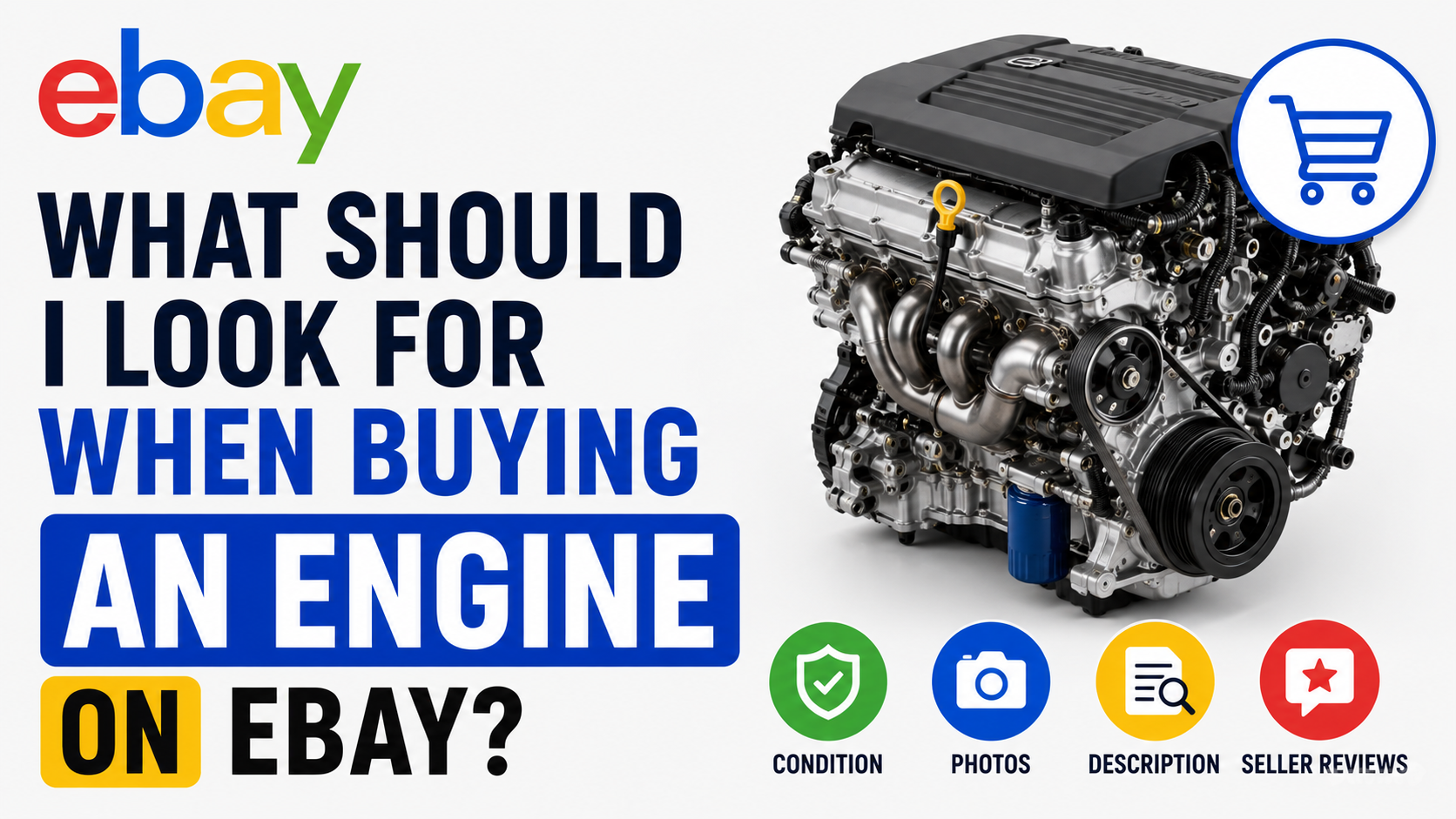
What Should I Look for When Buying an Engine on eBay?
A cheap engine listing can turn into an expensive mistake fast if you skip the checks that actually matter. Here's what to verify — compatibility, mileage, storage condition, and seller history — before you buy an engine on eBay Motors and Auto Parts.
Calculate Your eBay Selling Fees
Our free eBay Fee Calculator automatically calculates final value fees, promoted listing fees, international fees, regulatory fees, store subscription discounts, and different category-specific fee structures. See your estimated eBay fees, profit, and profit margin in seconds before you list.
Open Free eBay CalculatorWhat to Look for When Buying an Engine on eBay Motors: Buyer's Checklist
Purchasing a used engine on eBay Motors represents one of the highest-stakes transactions available on the platform. Unlike smaller automotive components, an engine is a significant financial investment, carries substantial shipping costs, and bears the risk of compatibility failure or mechanical defects that may not be immediately apparent. The eBay Engine Marketplace offers genuine savings over dealerships and specialty suppliers, but those savings are only realized if you systematically verify the factors that a good listing photo cannot communicate on its own.
This guide provides a structured, evidence-based methodology for evaluating engine listings on eBay, organized as a comprehensive pre-purchase checklist that covers compatibility verification, seller due diligence, configuration assessment, and shipping logistics.
Key Takeaways
- Verify compatibility through the exact engine code, not the listing title. Cross-check your vehicle's engine code against the listing and request documentation confirming the engine's origin.
- Demand clear sourcing history. Ask why the engine was pulled, whether it was running at removal, and request supporting documentation.
- Require visual evidence. Comprehensive photographs and, ideally, a running video are essential for assessing condition before purchase.
- Understand the configuration classification. Know whether you are buying a short block, long block, or complete engine, and budget for additional parts accordingly.
- Verify mileage claims with documentation. A verbal mileage figure without supporting evidence is an estimate, not a fact.
- Analyze seller feedback specifically for engine transactions. A high overall score is insufficient; search for comments about large-part sales to assess reliability.
- Confirm the return policy before buying. Understand the return window, who pays shipping, and whether eBay Money Back Guarantee applies.
- Get the real shipping cost upfront. Factor freight, crating, liftgate delivery, and insurance into your total cost comparison.
- Assess storage conditions. An engine stored properly—capped, drained, and covered—is significantly lower risk than one exposed to the elements.
1. The eBay Engine Marketplace: Scale and Risk
eBay Motors and Auto Parts has grown into one of the largest online marketplaces for used, rebuilt, and new-old-stock engines. The platform draws from a vast pool of sellers—ranging from salvage yards and specialty engine rebuilders to individual mechanics—resulting in more inventory and more competitive pricing than most local options can match. The eBay Engine Marketplace covers everything from complete crate engines to individual short blocks, often priced well below dealership or specialty engine shop rates.
This scale is precisely why due diligence matters more here than almost anywhere else you might source an engine. With so many sellers offering competitive pricing, quality and honesty vary considerably from listing to listing. The savings are real, but so is the risk if you skip the verification steps outlined below.
2. Compatibility Verification: The Engine Code Standard
Compatibility is the single most common point of failure in engine purchases. Two engines that "fit the same model" are often not interchangeable once you account for model year changes, trim-level variations, and regional specification differences. Relying on a listing title alone is insufficient.
The Verification Protocol:
Begin by locating your vehicle's engine code, which is typically stamped on the engine block itself and also listed in your owner's manual. If you do not have access to the manual, you can derive the engine code from your Vehicle Identification Number (VIN) using a free online VIN decoder. Once you have this code, cross-check it against what the seller lists. If a listing does not specify the exact engine code, message the seller directly before purchasing. A reputable seller will have this information readily available. If they cannot provide it, treat this as a significant red flag and consider moving on to another listing.
Documentation Requirement: When the seller provides an engine code, request documentation confirming that the engine came from a vehicle with that specific code. This may include donor vehicle records, salvage yard documentation, or photographs of the engine code stamping itself. Verifying this documentation reduces the risk of receiving an engine that superficially matches but is technically incompatible with your vehicle's mounting points, wiring harness, and engine control systems.
3. Sourcing History: How and Why the Engine Was Pulled
A seller who can explain why an engine came out of its original vehicle is inherently more trustworthy than one who cannot. The sourcing history provides critical context for assessing the engine's condition and remaining service life.
Key Questions for the Seller:
- Was the donor vehicle wrecked, or did the engine itself fail?
- How many miles were on the vehicle when the engine was pulled?
- Was the engine running at the time of removal?
Common, legitimate reasons for engine removal include a totaled vehicle with low mileage, a transmission failure unrelated to the engine, or a salvage-yard teardown where the engine was not the source of the failure. Vague answers—or no answer at all—should make you cautious. If the seller cannot or will not answer these questions clearly, treat that as a signal to continue your search rather than assume the best.
Documentation Expectation: A seller with a verifiable sourcing history should be able to provide supporting records, such as salvage yard paperwork, insurance total-loss documentation, or photographs of the donor vehicle showing the nature of the damage. This documentation not only confirms the sourcing history but also helps substantiate any mileage claims.
4. Visual Evidence: Photographs and Running Videos
Listing photographs matter more for engines than for almost any other used part category, because so much of an engine's condition is invisible from the exterior. A seller's willingness to provide comprehensive visual evidence is a strong indicator of their confidence in the product.
Required Photographs:
The listing should include clear shots of the exterior showing any visible corrosion, oil residue, or damage. Photographs of the intake and exhaust ports are essential, as rust or debris in these areas can indicate internal issues. Images of the oil pan and valve covers should be checked for leaks or evidence of prior repair work. If the listing does not include these angles, request them from the seller.
Running Video Evidence:
A video of the engine actually running—whether on a stand or still installed in the donor vehicle—is the single most valuable piece of evidence a seller can provide. A running engine demonstrates that the engine starts, idles, and operates without obvious mechanical issues such as knocking, smoking, or misfiring. A seller who is confident in what they are selling will typically have no problem providing a startup video on request, even if it is not included in the original listing. If a seller resists this request, it is worth asking why. Resistance to providing a video should be treated as a significant warning sign.
5. Configuration Classification: Short Block, Long Block, and Complete Engine
Engine listings use specific terminology that changes what you are actually paying for. Understanding these classifications prevents you from comparing prices across fundamentally different product categories and ensures you budget appropriately for additional parts and labor.
Configuration Definitions:
A short block includes the engine block, crankshaft, pistons, and connecting rods, but no cylinder head. This configuration requires you to source a cylinder head and valvetrain components separately. A long block includes everything in a short block plus the cylinder head, camshaft, and valvetrain. This is a more complete assembly but still lacks accessories. A complete or dressed engine includes all of the above plus accessories such as the intake manifold, exhaust manifolds, sensors, and sometimes ancillary components like the alternator or starter.
If a listing simply says "engine" without specifying which configuration it represents, message the seller before buying. The price difference between a short block and a complete engine can be substantial, and installing a short block requires sourcing additional parts, which adds real cost and labor you may not have planned for.
6. Mileage Verification: Documentation Over Verbal Claims
Mileage is one of the most frequently cited numbers in engine listings, and also one of the easiest to misstate, whether intentionally or not. A low-mileage claim is only as reliable as the documentation behind it.
Documentation Requirements:
Request documentation that substantiates the mileage claim. This may include a photograph of the donor vehicle's odometer, a build sheet, or salvage yard records tying the engine to a specific VIN. Sellers pulling from documented salvage vehicles can typically provide this without hesitation. If a seller can only offer a verbal number with nothing to back it up, treat the stated mileage as an estimate rather than a confirmed fact. Factor this uncertainty into your pricing evaluation and consider whether the premium for a low-mileage claim is justified without supporting evidence.
Odometer Consistency: If documentation is provided, verify that the mileage stated in the listing matches the mileage shown on the odometer photograph or salvage yard records. Inconsistencies between different documentation sources are a red flag that warrants further inquiry or outright rejection of the listing.
7. Seller Evaluation: Feedback Analysis for Large-Part Transactions
A seller's overall feedback score matters less than what that feedback specifically says about engine or large-part transactions. A seller with thousands of positive reviews for small accessories can still be inexperienced or unreliable when it comes to shipping and accurately describing something as complex as an engine.
Feedback Analysis Protocol:
Open the seller's feedback profile and search specifically for comments mentioning engines, transmissions, or similarly large components. What you are looking for is a track record of accurately described large parts and smooth shipping. Comments about accurate condition descriptions are particularly valuable, as they indicate the seller's ability to honestly represent the product. Pay attention to any negative feedback mentioning misrepresented mileage, hidden damage, or shipping problems. A pattern of complaints about accuracy on large parts is a stronger warning sign than a single bad review buried in hundreds of positive ones for small items.
Top Rated Seller Status: Also check whether the seller has achieved Top Rated Seller status, which indicates consistently high performance across multiple metrics including shipping speed, communication, and customer satisfaction. While not a guarantee of quality, Top Rated Seller status provides an additional layer of assurance.
8. Return Policy and Buyer Protection Assessment
Engines are expensive enough that a bad return policy can turn a mistake into a real financial loss. Understanding the return terms before purchasing—not after—is essential for managing risk.
Return Policy Verification:
Confirm whether returns are accepted at all, and the window for filing one. Some sellers offer only a brief return window that may not provide sufficient time for a full inspection or installation attempt. Determine who pays return shipping, which can run into the hundreds of dollars for something engine-sized. Verify whether the listing is covered by eBay Money Back Guarantee, and what that actually covers if the engine arrives significantly not as described. Many sellers list engines as final sale, or with a short return window that does not leave time for a full inspection. If that is the case, budget for the possibility that a problem only surfaces after installation, and price your risk accordingly.
Inspection Timing: If the return window is short, consider whether you can realistically install and test the engine within that timeframe. If not, factor that limitation into your decision and potentially look for listings with more generous return policies.
9. Shipping and Crating: The Landed Cost Component
Engines are heavy, awkward freight items, and shipping cost is often underestimated by first-time buyers. The total landed cost—item price plus shipping—is what matters, not the item price alone.
Shipping Verification Checklist:
Determine whether the engine ships via freight, which is common for anything over approximately 150 pounds, and what that adds to the total cost. Inquire about how the engine is crated or palletized, as inadequate packaging is a leading cause of shipping damage on engines. Check whether liftgate delivery is included, since you will likely need this service without access to a loading dock. Confirm insurance coverage on the shipment, particularly for anything above a few hundred dollars in value.
Cost Evaluation: A "cheap" engine that costs several hundred dollars extra to ship freight is not actually the deal it appears to be on the listing page. Always get the real, all-in shipping cost before comparing prices across sellers. Request the total shipping quote in writing from the seller or verify it through the listing's shipping calculator.
10. Storage Condition Assessment: Signs of Neglect
An engine that has been sitting outside, uncovered, for months tells a very different story than one stored indoors immediately after removal. Storage conditions meaningfully affect engine condition and should be part of your evaluation.
Key Questions on Storage:
Ask about the storage conditions from removal to present. Look for rust on external surfaces, particularly around the exhaust manifold and intake, as this indicates exposure to moisture. Determine whether the engine was drained of fluids or left with old oil and coolant inside, as residual fluids can cause internal corrosion over time. Check for signs of rodent or pest intrusion, which can cause hidden damage to wiring or intake components. Confirm whether openings such as the intake and exhaust were capped or plugged during storage to prevent debris and moisture entry.
Condition Indicator: An engine stored properly—capped openings, drained fluids if long-term, kept indoors or covered—represents a meaningfully lower-risk purchase than one photographed sitting exposed on a pallet outdoors. If the listing does not address storage conditions, ask the seller directly before purchasing.
FAQ:
How do I know if an eBay engine actually fits my car?
Match the exact engine code—not just the year, make, and model—against your vehicle's engine code, found in your owner's manual or through a VIN decoder. Message the seller directly if the listing does not specify the code, as "fits your model" claims can be inaccurate across trim levels and production years.
What's the difference between a long block and a short block engine?
A short block includes the engine block, crankshaft, pistons, and connecting rods, but no cylinder head. A long block adds the cylinder head, camshaft, and valvetrain. A complete or dressed engine includes all of that plus accessories like intake and exhaust manifolds. The price and installation cost differ significantly between the three configurations.
Can I trust the mileage listed on an eBay engine?
Only if it is backed by documentation—an odometer photo, salvage yard paperwork, or a build sheet tied to a VIN. A mileage figure with no supporting evidence should be treated as an estimate rather than a confirmed number.
Does eBay's return policy cover a bad engine purchase?
It depends on the individual seller's return policy and whether the listing is protected under eBay Money Back Guarantee. Some sellers list engines as final sale or with a short return window, so confirm return terms and who covers return shipping before you buy.
How much does it typically cost to ship an engine?
Engines over approximately 150 pounds usually ship via freight rather than standard parcel carriers, which adds meaningful cost—often calculated separately from the item price. Always get the full shipping quote, including whether liftgate delivery is included, before comparing the total cost across listings.
Is eBay actually a good place to find discount auto parts?
Yes, generally. eBay Motors and Auto Parts draws a large enough pool of sellers, including salvage yards and independent mechanics, that pricing is often meaningfully lower than a dealership or specialty shop. The tradeoff is that quality and seller reliability vary more than they would at a single specialty retailer, which is precisely why compatibility checks, seller feedback, and return policy matter more when shopping the eBay Engine Marketplace than they might elsewhere.

eFee Editorial Team
The eFee Editorial Team publishes research-driven content to help eBay sellers better understand marketplace fees, pricing strategies, shipping costs and profitability. Our articles are regularly updated to reflect the latest eBay fee structures and seller best practices.
Reviewed periodically to reflect the latest eBay marketplace fee updates.
Was this article helpful?
Your feedback helps us improve future articles.