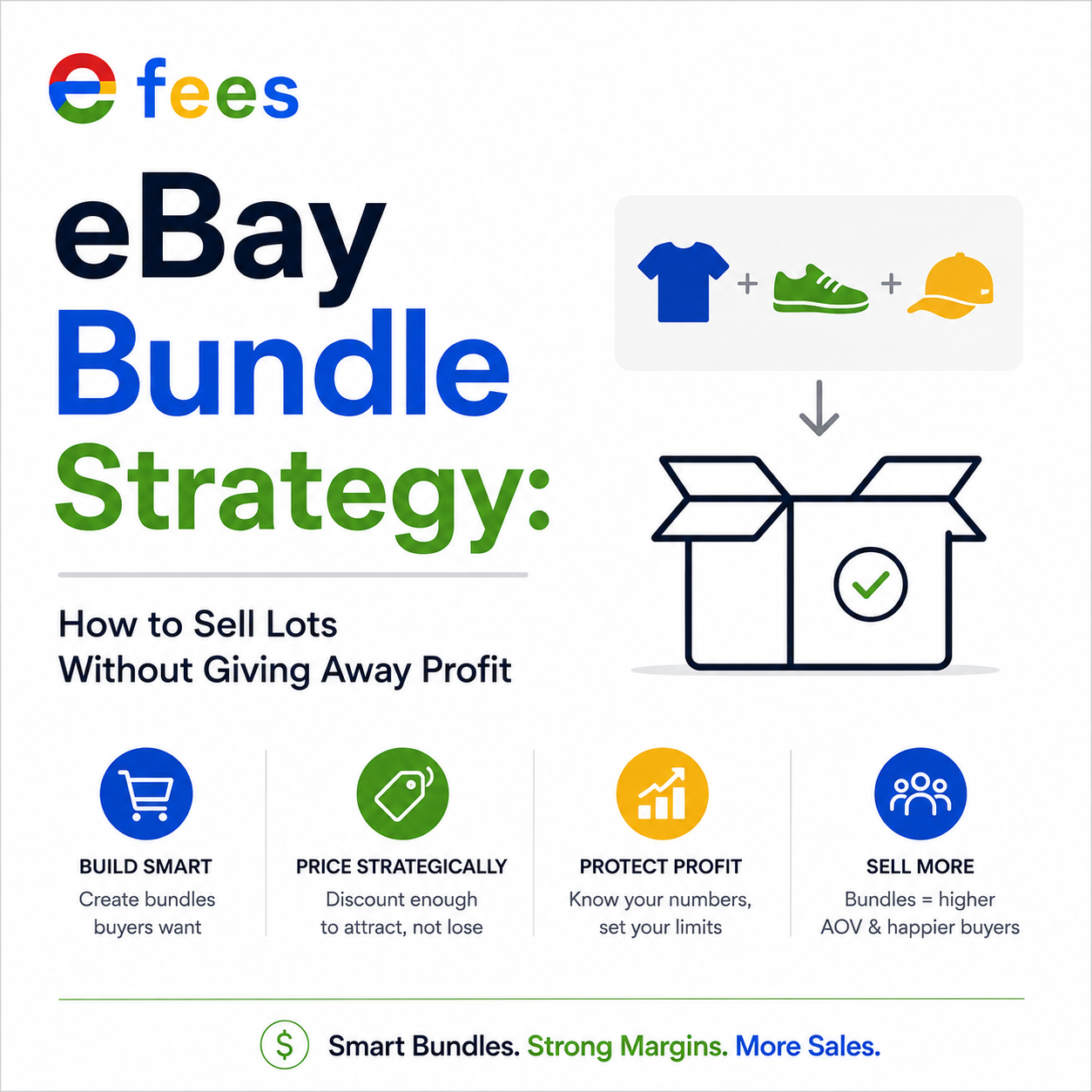
eBay Bundle Strategy: How to Sell Lots Without Giving Away Profit
Bundling low-value inventory feels smart until you do the math and realize you cleared $6 on six items. Here's the reseller-specific framework for pricing, photographing, and describing lots that actually protect your margins—including the anchor item strategy and the three questions that separate curation from desperation.
Calculate Your eBay Selling Fees
Our free eBay Fee Calculator automatically calculates final value fees, promoted listing fees, international fees, regulatory fees, store subscription discounts, and different category-specific fee structures. See your estimated eBay fees, profit, and profit margin in seconds before you list.
Open Free eBay CalculatorThe Bundle Trap: A Guide to Profitable eBay Lots
You have six video games that nobody wants individually. A copy of Madden 2014. Some Wii shovelware with a cracked case. A strategy guide for a game you don't even have. Alone, each one sits in a bin for six months, collecting dust and killing your sell-through rate. So you do what every reseller does eventually. You throw them in a lot. Six games, one price, free shipping. It sells in four days. You celebrate. Then you do the math.
You sold the lot for $22. Shipping was $9. eBay took $4. You paid $12 for the games originally. After fees, postage, and the bubble mailer, you cleared approximately $6. For six items. That took you an hour to photograph, twenty minutes to describe, and another fifteen minutes to pack carefully. You made roughly a dollar per item.
That is the bundle trap. It feels like liquidation. It feels like strategy. But most of the time, you are simply discounting your own inventory into oblivion because separating it felt like too much work. This guide provides a structured, data-driven framework for bundling that protects your margins, attracts the right buyers, and prevents your store from becoming a clearance bin.
Key Takeaways
- Bundle for complementary value, not desperation. The sum should create something the parts cannot. If you are bundling because items will not sell alone, address the underlying issue first.
- Price using sold comps, not aspirational individual values. Your ceiling is what similar lots actually sold for. Your floor is your break-even plus margin. Price between the two.
- The anchor item strategy is the exception. Lead with one desirable item to justify the price. Attach dead stock to move it without discounting the anchor's value.
- Photograph with intention. Everything must be visible. The hero shot is straight down on a clean surface. Detail shots include all flaws. Numbered photos prevent confusion.
- Describe every item individually. Every item gets its own line with condition and flaws. Vagueness is the leading cause of disputes. If an item is damaged, state it explicitly.
- Calculate shipping before you list. Weigh the complete lot in the box you will use. Build the cost into your price. Free shipping on lots is dangerous unless you know the worst-case scenario.
- Audit your lots regularly. If more than 20% of your listings are lots, you have a sourcing problem. Write off the loss, clear the space, and buy better next time.
1. Why Most Resellers Bundle Wrong
Most resellers bundle for the wrong reason. They do not bundle to increase profit. They bundle to decrease pain—the pain of looking at that bin of low-value inventory, the pain of listing something for $8 and realizing fees eat half of it, the pain of admitting they bought a dud. So they shove the duds together, slap a discount on the pile, and call it a business strategy.
This approach works exactly once. Then you have a store full of lots that trained your buyers to expect bulk pricing on everything. Why buy your single vintage mug for $18 when they can wait for you to panic and bundle it with three others for $15? You have taught them that your individual prices are imaginary.
The Right Reason to Bundle: Complementary Value
You bundle when the sum creates something the parts cannot. A camera body with a lens, a strap, and a memory card is a starter kit. A set of vintage kitchen canisters in graduated sizes is a collection. A lot of ten blank VHS tapes is inventory for a niche buyer who needs them and does not want to hunt individually. These bundles work because the buyer is not just getting items—they are getting convenience, completeness, or a curated set.
The Wrong Reason to Bundle: Desperation
If you are bundling because the items will not sell alone, you need to ask why they will not sell. Bad photos? Overpriced? Out of season? Dead category? Bundling does not fix those problems. It just hides them in a bigger box. Sometimes the correct move is to donate the $4 item and free up the bin space. Not every piece of inventory deserves a listing. Not every listing deserves a bundle.
The Bundle Reason Test:
Before you create a lot, run three diagnostic questions. First, would any of these items sell individually within sixty days at a fair price? If yes, do not bundle it. You are giving away profit. Second, does this bundle solve a specific buyer problem? A "beginner pottery kit" with clay, tools, and a wheel solves a problem. A "box of random craft supplies I need gone" does not. Third, am I bundling to save time or to make money? If the answer is time, you are not bundling. You are quitting. And quitting should look like a donation pile, not a discounted listing.
2. The Pricing Math: How to Not Give Away the Farm
This is where resellers consistently destroy their own margins. They price bundles by adding up the individual values and cutting the total in half. It feels logical. It feels generous. It feels like a deal that buyers cannot refuse. What it actually is, is a confession that your individual prices were fantasy.
Consider four video games. You would list them individually at $15, $12, $10, and $8. Total: $45. So you bundle them at $22—approximately 50% off. Feels like a steal. But those individual prices were aspirational. The $15 game has been sitting for ninety days with three watchers who never pulled the trigger. The $8 game has zero interest. The market already told you those prices were wrong. So your "50% off" is not a discount on real value. It is a discount on a delusion.
The Correct Pricing Methodology:
Start with actual sold comps. Not active listings. Not your wish prices. Search eBay sold listings for "Wii game lot 4 games," "vintage mug set of 4," or "pottery starter kit." That number is your ceiling, not your starting point. A lot's value is almost always less than the sum of its parts. Buyers expect a bulk discount. That is fine. But you need to know the real market value before you decide how deep to cut.
Calculate Your Bundle Floor:
Once you have the sold comp range, calculate your minimum acceptable price. Factor in everything: your sourcing cost for all items, eBay's final value fee on the total, shipping (which gets complicated fast with multi-item lots), packaging (which often requires a box instead of a mailer), and your time. Photographing and describing four items as a lot takes almost as long as listing one item, but the profit is spread thinner.
Your listed price should sit between your ceiling (the sold comp) and your floor (your break-even plus margin). If the market will not pay your floor, the bundle should not exist. Donate the items. Take the loss. Do not turn it into a listing that trains buyers to expect bottom-feeder prices.
The Anchor Item Strategy:
The exception that makes bundling genuinely profitable is the anchor item strategy. Lead with one desirable item—a sought-after vintage sweater, a popular game, a name-brand kitchen gadget. Then attach two or three lower-value, slower-moving items to it. The anchor justifies the price. The extras justify the buyer's feeling that they are getting a deal. The key is that the anchor could sell individually, but you are choosing to bundle it to move the dead stock. Price at roughly the anchor's solo value plus a small premium. The buyer pays a little more than the anchor alone but feels like they received three bonus items. That is a real bundle strategy, not a desperation pile.
3. Photography: How to Not Look Like You Are Running a Garage Sale
A bundle photo has one job: it must make the buyer feel like they are buying a curated collection, not someone's junk drawer dumped onto a bedsheet. The difference is entirely in presentation.
The Hero Shot:
Everything must be visible in one frame. No mystery boxes. No "see other photos for individual items" as your primary image. The main photo is the only photo most buyers will ever look at. If they cannot immediately see every item in the lot, they will either scroll past or open a case later claiming something was hidden.
Lay the items out on a clean, neutral surface—a white poster board or light gray fabric. Arrange them with intention. The anchor item gets center placement. Supporting items radiate outward. Nothing overlaps in a way that hides condition. Nothing is stacked where a flaw gets obscured. If you have ten items, two rows are fine. But the arrangement should look deliberate, like a flat lay, not a pile.
Take the hero shot from directly above. Straight down. No angle. Angles create distortion and make items look smaller or larger than they are. The straight-down shot is honest and is also the easiest to make look professional with minimal editing.
Detail Shots:
Then take three to five detail shots. Shot two is the anchor item close up. Shot three is any flaw on any item in the lot—if one mug has a chip, photograph the chip; if one game case is cracked, photograph the crack. Shot four is the back, bottom, or interior of the anchor item. Shot five is a group shot from a slight angle that shows depth and dimension, so the buyer understands these are physical objects with weight and texture.
The Numbered Photo Strategy:
If you have more than six items in the lot, consider a numbered photo. Lay everything out. Place a small numbered sticker next to each item. Take the photo. Then reference those numbers in your description. "Item 1: Anchor sweater. Item 2: Bonus scarf." This prevents the inevitable message: "Which sweater is the blue one?" The photo becomes your documentation. The numbers become your shield.
What Not to Do:
Never use a cardboard box as your backdrop. Never photograph a lot on your carpet. Never include your foot, your coffee cup, or your cat in the frame. Professionals do not sell junk drawers. They sell curated lots. And curation starts with the photo.
4. The Description: How to Not Get a Case Opened
Bundle descriptions are where resellers get destroyed. Not because they lie. Because they are vague. And vagueness is a lawsuit in slow motion.
You cannot describe a lot the way you describe a single item. "Vintage mug set, great condition, minor wear" is a death sentence when one mug has a hairline crack and another has faded glaze. The buyer sees "great condition," receives a cracked mug, and opens a case. You lose. Not because you were dishonest. Because you were lazy.
The Item-by-Item Format:
Every single item in the lot needs its own line, its own condition note, and its own specific flaw callout. Here is the format that works:
Item 1: Anchor piece. Brand, size, material, condition. Specific flaw if any. "Vintage Levi's 501, 32x32, dark wash, excellent condition, minor fading at knees visible in photo 2."
Item 2: Supporting piece. Brand, size, material, condition. "Hanes beefy tee, size L, heather gray, good condition, small stain on hem visible in photo 3."
Item 3: Filler piece. "Bonus item: unbranded canvas belt, one size, fair condition, scuffed buckle."
The Lot Disclaimer:
Include a lot disclaimer at the bottom: "All items sold as described. Please review photos and item list carefully. No returns on bundled lots unless items arrive damaged in transit." eBay may not enforce the last sentence, but it sets expectations. And expectations are half of dispute prevention.
If an item in the lot is damaged, non-functional, or incomplete, state it explicitly. "Game 4: Disc only, no case, tested and working." Do not hide this in the middle of a paragraph. Put it in the item list where it cannot be missed. Buyers who are surprised open cases. Buyers who knew exactly what they were getting leave positive feedback.
The Title:
The title needs to signal "lot" immediately. "Lot of 4 Vintage Nintendo Wii Games" is better than "Wii Game Bundle." "Bundle" can mean two items. "Lot" implies volume. Use numbers in the title. "Set of 3," "Lot of 8," "Collection of 5." Numbers help buyers understand the scope before they click.
5. When to Bundle and When to Split
Not everything should be bundled. In fact, most things should not. Here are the rules.
Bundle when: you have complementary items that create a complete experience—camera plus lens plus bag, three matching canisters, a starter kit of anything. Or when you have dead stock that shares a category and will not move alone, but you have an anchor item that justifies the lot price.
Split when: any individual item in the lot is worth more than $25 on its own. If you have a vintage jacket worth $40 and three shirts worth $8 each, do not bundle them. You are giving away the jacket's margin to move shirts that should have been donated. List the jacket alone. Donate the shirts. Or lot the shirts separately if you must.
Split when: the items appeal to completely different buyers. A lot containing a vintage band tee, a kitchen timer, and a phone case is not a lot. It is three items that happened to be in your car at the same time. No buyer wants all three. You are not bundling. You are creating a listing that only appeals to people who buy random junk, which is a small and depressing market.
Bundle when: shipping efficiency makes the math work. Two heavy books that cost $8 each to ship individually can ship together for $10. The buyer saves on shipping. You save on packaging. The bundle makes economic sense for both parties. This is especially true for media, small electronics, and anything where weight drives postage costs.
Never bundle when: you are doing it because listing individually feels like too much work. That is not strategy. That is procrastination wearing a business hat. If the items are worth listing separately, list them separately. If they are not worth listing separately, donate them. The middle ground of "shove them in a lot so I do not have to think about them" is how you end up with a store full of $12 lots that take forty-five minutes each to pack and ship.
6. Shipping the Lot: Without Losing Money or Items
Shipping bundles is where profit dies quietly. You priced the lot at $28 with free shipping because that is what the market supports. Then you discover that six video games in a box with bubble wrap weighs three pounds and costs $12 to ship cross country. Your $28 sale just became a $16 sale. After fees, you made $4 for six items.
Calculate Shipping Before You List:
Weigh the complete lot in whatever box you will actually use. Add a pound for packing materials if you are being safe. Then build that cost into your price or charge calculated shipping. Free shipping on lots is dangerous unless you know exactly what the worst-case postage scenario looks like. Media Mail is your friend for books and media. Flat Rate boxes are your friend for heavy small items. First Class is rarely your friend for lots because lots usually cross the one-pound threshold quickly.
Pack with Internal Organization:
Do not just throw six items in a box and hope. Wrap each item individually. Arrange them so nothing shifts. Include a packing slip that lists every item. Not for the buyer's convenience. For your protection. If they claim something was missing, you have documentation of what was packed. Photograph the packed box before you seal it. One photo. Thirty seconds. Potential case evidence.
7. The Real Talk
Here is the hardest truth about bundling. Most resellers use it as a way to avoid admitting they made bad buying decisions. That liquidation pallet of phone cases. Those thrift store books that turned out to be worthless. The craft supplies from the estate sale that nobody wants. Bundling them feels like you are being resourceful, like you are squeezing lemonade from lemons. But sometimes a lemon is just a lemon. And squeezing it takes time that you could spend sourcing inventory that actually sells.
The best bundles in your store should look like curation, like intention, like a buyer stumbled into a collection that was assembled just for them. The worst bundles look like a storage unit cleanout. Buyers can tell the difference. They can feel it in the photos, in the description, in the price. And they pay accordingly.
If more than 20% of your active listings are lots, you have a sourcing problem, not a bundling problem. You are buying too much dead stock. You are not being selective enough at the thrift store. You are letting "it was cheap" override "it has demand." Bundling is not a cure for bad sourcing. It is a bandage. And bandages do not fix broken legs.
8. The Bottom Line
The goal is not to move every piece of inventory you ever bought. The goal is to make money. Sometimes the way to make money is to write off the loss, clear the space, and buy better next time. Bundling can be part of that. But only when it is strategic. Only when it is curated. Only when the math actually works.
Audit your lots. Look at the ones that sold. How much profit per item did you actually make? Look at the ones that have not sold. How long have they sat? If your lots have worse sell-through than your individual listings, you are bundling wrong. If your lots attract more cases and returns than your individual listings, your descriptions are too vague. Fix it. Or stop bundling and start donating.
Q&A:
Question: When should I bundle items instead of selling them individually?
Short answer: Bundle when items are complementary and create a complete set or starter kit. Bundle when shipping efficiency makes the math work. Do not bundle simply because items will not sell individually—address the underlying issue first.
Question: How should I price a bundle to maximize profit?
Short answer: Start with sold comps for similar lots. That is your ceiling. Calculate your floor by factoring in sourcing cost, eBay fees, shipping, packaging, and your time. Price between the two. If the market will not pay your floor, do not list the bundle.
Question: What is the anchor item strategy?
Short answer: Lead with one desirable item that could sell individually. Attach two or three lower-value, slower-moving items to it. Price at roughly the anchor's solo value plus a small premium. The buyer pays a little more than the anchor alone but feels like they got bonus items. You clear dead stock.
Question: How do I write a description that prevents cases?
Short answer: Every item gets its own line with brand, size, material, condition, and specific flaws. Include a lot disclaimer. If an item is damaged, state it explicitly. Vagueness is the leading cause of bundle disputes.
Question: What is the biggest mistake resellers make with bundles?
Short answer: Bundling out of desperation rather than strategy. If more than 20% of your listings are lots, you have a sourcing problem, not a bundling problem. Bundling is a bandage for bad buying decisions, not a cure.

eFee Editorial Team
The eFee Editorial Team publishes research-driven content to help eBay sellers better understand marketplace fees, pricing strategies, shipping costs and profitability. Our articles are regularly updated to reflect the latest eBay fee structures and seller best practices.
Reviewed periodically to reflect the latest eBay marketplace fee updates.
Was this article helpful?
Your feedback helps us improve future articles.