
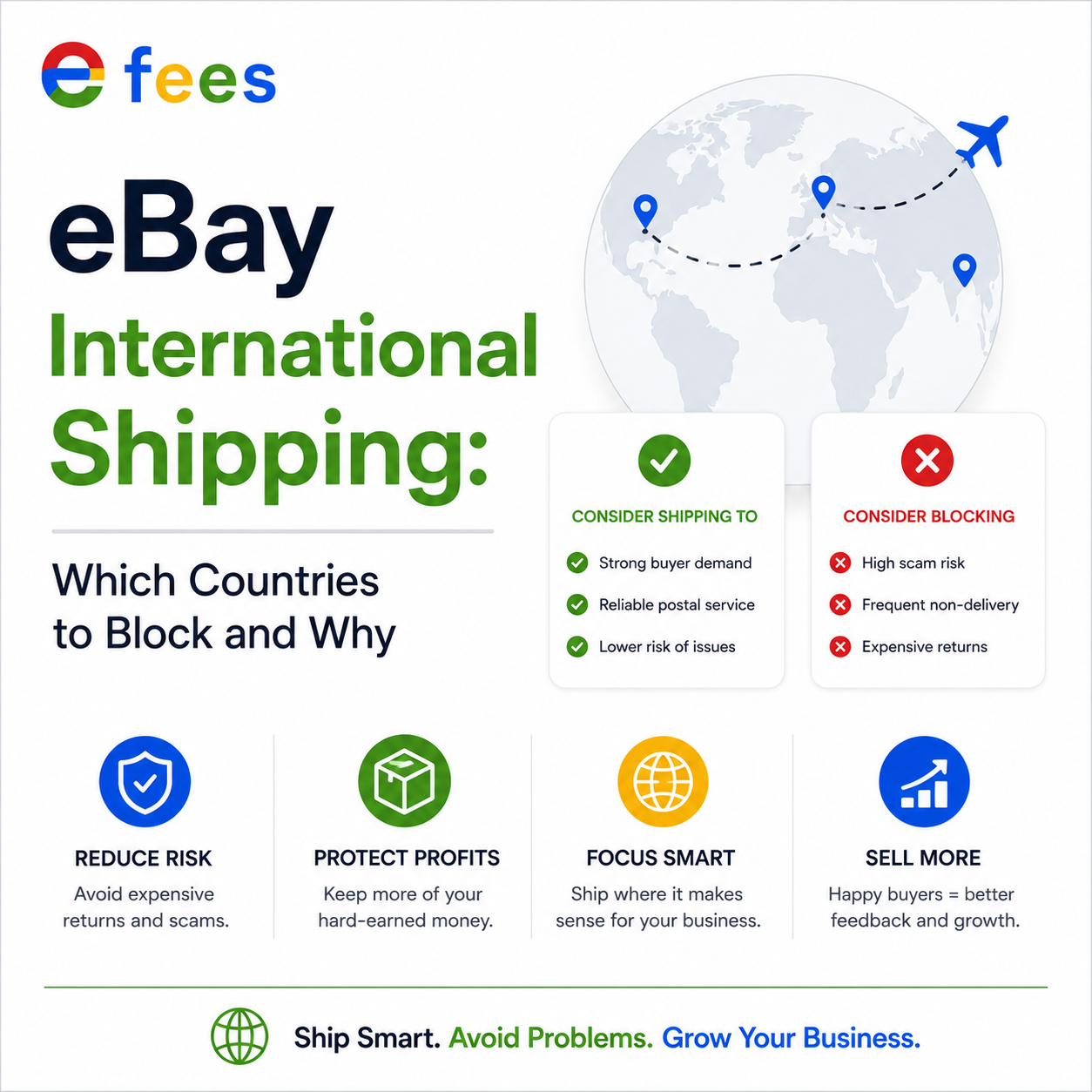
eBay International Shipping: Which Countries to Block and Why?
That vintage jacket you shipped to Milan? It's stuck in customs, the buyer opened a case, and eBay refunded them instantly. Here's the real block list that experienced resellers use to protect their margins from customs disasters, tracking black holes, and buyer protection loopholes that only hurt sellers.
Calculate Your eBay Selling Fees
Our free eBay Fee Calculator automatically calculates final value fees, promoted listing fees, international fees, regulatory fees, store subscription discounts, and different category-specific fee structures. See your estimated eBay fees, profit, and profit margin in seconds before you list.
Open Free eBay CalculatorInternational Shipping on eBay: A Guide to Country Risk Assessment and Seller Protection
You sold a vintage jacket to a buyer in Milan for $75. You shipped it via USPS International. Three weeks later, the tracking stalled somewhere in Italian customs. The buyer opened an Item Not Received case. eBay refunded them immediately because the tracking never showed delivery. Two months after that, the package showed back up at your door, battered, opened, and stamped with so many customs stickers it looked like modern art. You were out the jacket, the money, and the shipping cost.
This scenario is not uncommon. Every eBay reseller who expands internationally eventually encounters this wall. International selling is not simply domestic selling with a longer shipping label—it is a completely different risk profile where one bad transaction can wipe out the profit from ten good ones. Customs delays, fraudulent Item Not Received claims, packages that vanish into foreign postal systems, and buyers who know how to exploit eBay's buyer protection across borders all contribute to a risk landscape that requires strategic management.
This guide provides a structured, data-driven analysis of international shipping risks, country-by-country assessments, and practical strategies for protecting your margins and seller metrics.
Key Takeaways
- eBay's buyer protection heavily favors buyers in international disputes. Without delivery confirmation, you usually lose. This is the foundational risk of international selling.
- Italy and Brazil are the highest-risk countries. Customs delays, tracking blackouts, and buyer behavior patterns make them consistently problematic. Block them or use GSP only.
- Canada, the UK, Australia, Germany, and Japan are the safest international markets. Reliable postal systems, reasonable customs, and straightforward dispute resolution make them worth the extra shipping effort.
- The Global Shipping Program transfers risk to eBay. Use it for any country where you are unsure about direct shipping. The buyer pays more, but your protection is worth the trade-off.
- International cases have metric impact. A single lost international shipment can hurt your seller performance, trigger fee surcharges, and bury your listings in search.
- Audit your international sales regularly. Count cases, calculate costs, and evaluate whether the extra sales from risky countries are worth the headaches. Usually, they are not.
- Set your shipping preferences strategically. Block problem countries, enable GSP for the rest, and ship to Canada like it is domestic. An empty excluded locations list is not strategic—it is hopeful.
1. The Core Problem: eBay's Buyer Protection and International Tracking
The foundational issue with international shipping on eBay is that eBay's Money Back Guarantee heavily favors buyers in international disputes, especially when tracking does not show a clear delivery scan. Domestic shipping offers multiple layers of protection: tracking, delivery confirmation, and signature options. International shipping often dumps your package into a foreign postal system where tracking goes dark, delivery confirmation does not exist in the same way, and the buyer can claim they never received the item.
eBay typically sides with the buyer because they cannot prove delivery either. And because you are the seller, you absorb the loss. Not eBay. Not the postal service. You. This risk is compounded by the fact that an international Item Not Received case counts against your seller performance exactly the same as a domestic one—it hits your defect rate, can push you Below Standard, and can trigger fee surcharges while burying your listings in search results.
2. Country Risk Assessment: Where to Block, Where to Ship
High-Risk Countries
Italy is the most frequently cited problem country in reseller forums. Not because Italian buyers are dishonest, but because Italian customs is notoriously slow and unpredictable. Packages sit for weeks or months. Buyers become frustrated and open cases before the package clears. Even when the item eventually arrives, the buyer has often already been refunded and has no incentive to refuse the delivery or send the money back. Italian customs also has a reputation for opening packages for inspection and not repacking them properly, leading to damage claims that are difficult to contest from across an ocean. Experienced resellers either block Italy entirely or only ship there through eBay's Global Shipping Program, where eBay handles customs and the risk shifts away from the seller.
Brazil is another frequent entry on the block list. Brazilian customs aggressively inspects packages, duties are high and unpredictable, and buyers sometimes refuse packages because they do not want to pay the import taxes. When a buyer refuses a package, it is returned to you—sometimes weeks later, sometimes never—and eBay still refunds the buyer because the tracking does not show delivery. Brazil also has a higher incidence of freight forwarder addresses, where buyers use Miami forwarding services. These transactions appear domestic but are shipped internationally, which voids your seller protections if something goes wrong. Addresses containing "Suite," "Apt," or a company name in Florida with a buyer in São Paulo are red flags.
France presents a different issue. French postal service, La Poste, has problems with packages marked as delivered that buyers claim they never received. Postal workers sometimes leave packages in unsecured locations, with neighbors, or in building lobbies. The tracking shows delivered. The buyer says it was not. eBay's system sees delivered and usually closes the case in your favor, but not always. Many resellers only ship to France via tracked courier services, which is expensive and only makes sense for higher-value items.
Mexico is a mixed case. eBay's Global Shipping Program handles Mexico reasonably well, but direct shipping through USPS can be problematic. Packages go through customs in Mexico City and then get handed off to Correos de México, where tracking often stops updating. Buyers in remote areas sometimes receive packages weeks after the estimated delivery window, by which time they have already opened an Item Not Received case. If shipping to Mexico, use GSP or a courier with end-to-end tracking; do not trust standard international mail for anything over $20.
Russia is essentially off-limits for most resellers now, not just because of geopolitical issues but because the postal system is unreliable and eBay's protections are thin for shipments there. Many sellers blocked Russia years ago and never looked back.
Low-Risk Countries
Canada is the gold standard for American resellers. USPS First Class International to Canada is affordable, tracking usually works end-to-end through Canada Post, customs is straightforward, and Canadian buyers are generally reasonable. The only wrinkle is Canada's strict biosecurity rules—no used soil, certain agricultural items, or wooden products without proper treatment—and customs can be slow during holiday seasons. Overall, Canada is the lowest-risk international market for US-based sellers.
The United Kingdom is also solid, especially since Brexit settled into a routine. UK buyers are accustomed to paying VAT on imports, eBay collects and remits it automatically for many transactions, and Royal Mail tracking is reliable. The main risk is the same as domestic selling: the occasional difficult buyer. From a shipping and customs perspective, the UK is manageable.
Australia and Germany are similarly reliable. Australian customs is efficient, though shipping costs are high due to distance. German buyers expect precision—accurate descriptions, exact measurements, thorough condition notes—and they will open cases if the item does not match. However, German postal tracking is excellent and disputes are usually resolvable with evidence.
Japan is another safe bet for collectibles, vintage fashion, or electronics. Japanese buyers are detail-oriented, rarely open frivolous cases, and the postal system is world-class. The risk is low, though shipping costs are high.
3. The Global Shipping Program: eBay's Risk Transfer Solution
The Global Shipping Program is eBay's official solution to international shipping risk. It is not perfect—it adds cost for the buyer, which can reduce sales—but it transfers the customs and delivery risk to eBay. Once your package reaches eBay's domestic hub, your responsibility ends. If it gets lost or delayed after that point, eBay handles the refund, not you.
For resellers who want international reach without international anxiety, GSP is the closest thing to a safety net. The buyer pays more in shipping and duties, but you sleep better. And if a buyer messages you asking you to ship outside GSP to save them money, say no every time. "Can you ship direct to avoid fees" is often the opening line of a transaction that will cost you your seller protections.
4. Direct Shipping Rules and Best Practices
If you do ship directly internationally, establish clear rules for yourself. No direct shipping to Italy, Brazil, or any country where tracking does not show delivery confirmation. Only ship via services that offer end-to-end tracking and delivery confirmation—Priority Mail International, Express Mail International, or couriers like DHL and FedEx. First Class International is cheap, but for many countries it only offers tracking until the package leaves the US. After that, it is a black hole, and black holes are where your money goes to die.
The Item Not Received Policy: If a package is stuck in customs for three weeks and the buyer opens a case, your options are limited. You can try to stall, explain that customs delays are normal, and hope the package clears before eBay forces a refund. But eBay's system does not care about customs delays. It cares about delivery confirmation. Without it, you usually lose. Either use GSP, use a courier with guaranteed delivery confirmation, or block the country. Those are your options.
5. The Metric Impact of International Cases
There is also the metric impact to consider. An international Item Not Received case counts against your seller performance exactly the same as a domestic one. It hits your defect rate. It can push you Below Standard. It can trigger the 6% fee surcharge and bury your listings in search results. So that one $30 sale to a risky country that turned into a case did not just cost you $30. It potentially cost you thousands in reduced visibility and higher fees.
The math on international shipping is not just about the sale. It is about what happens to your account if the sale goes wrong. This is why many experienced resellers take a hard line and only ship to Canada, the UK, Australia, and Germany—four countries. They leave money on the table from other markets, but they also leave the stress, the cases, and the customs disasters on the table too.
6. Practical Setup Instructions
Go to your eBay account settings. Find the Shipping Preferences section. Look for the option to exclude shipping locations. Block the countries that consistently cause problems: Italy, Brazil, and any others where you have personally had bad experiences.
For the countries you do ship to, enable the Global Shipping Program. Let eBay handle the customs nightmare. And if you ship directly, be ruthless about your policies.
Some resellers take an even harder line and only ship to Canada, the UK, Australia, and Germany. That is it. There is no right answer here, only your personal risk tolerance. If you are a solo reseller working part time, the last thing you need is a six-week dispute with a buyer in a country whose postal system you cannot even call.
7. The Real Talk
International buyers are not the problem. Postal systems, customs bureaucracies, and eBay's blanket buyer protection policies are the problem. A buyer in Rome who genuinely wants your vintage jacket is not trying to scam you. But Italian customs might sit on the package for a month, eBay might force a refund, and the buyer might end up with both the jacket and their money through no fault of their own. The system creates these outcomes. Your job is to opt out of the parts of the system that predictably destroy your profit.
Audit your international sales from the last year. Count how many went to Italy, Brazil, or other problem regions. Count how many turned into cases. Calculate what those cases cost you in refunds, lost inventory, and potential metric damage. Then ask yourself if the extra sales from those countries were worth it. Usually, the answer is no. Usually, the answer is that you could have made the same money shipping domestically and spent the time you wasted on disputes actually listing more inventory.
8. The Bottom Line
Block the bad actors. Use GSP for the rest. Ship to Canada like it is an extension of your domestic market. And stop treating every country on the map like a potential customer. Some of them are just potential headaches wearing a buyer account.
Now open your eBay shipping settings. Look at your excluded locations list. If it is empty, you are not being strategic. You are being hopeful. And hope is not an international shipping policy.
Q&A:
Question: Which countries should I block immediately as a US-based seller?
Short answer: Italy and Brazil are the most frequently cited problem countries due to customs delays, tracking issues, and buyer protection outcomes. Russia is essentially off-limits. France has delivery confirmation issues that make it risky without courier services.
Question: What is the safest international shipping method on eBay?
Short answer: eBay's Global Shipping Program transfers customs and delivery risk to eBay. Once your package reaches eBay's domestic hub, your responsibility ends. For direct shipping, use Priority Mail International, Express Mail International, or couriers like DHL and FedEx with end-to-end tracking. Avoid First Class International for any country where tracking goes dark after US departure.
Question: How do international Item Not Received cases affect my seller metrics?
Short answer: They count exactly the same as domestic cases. They hit your defect rate, can push you Below Standard, and can trigger fee surcharges. The metric impact often costs more than the refund itself.
Question: What is the red flag of a freight forwarder address?
Short answer: A Miami address with "Suite," "Apt," or a company name where the buyer is actually in Brazil or another international location. These transactions appear domestic but are shipped internationally, which voids your seller protections.
Question: Should I ship to Canada, and what are the risks?
Short answer: Canada is the lowest-risk international market for US sellers. Tracking usually works end-to-end through Canada Post, customs is straightforward, and Canadian buyers are generally reasonable. The only risks are strict biosecurity rules and customs delays during holiday seasons.

eFee Editorial Team
The eFee Editorial Team publishes research-driven content to help eBay sellers better understand marketplace fees, pricing strategies, shipping costs and profitability. Our articles are regularly updated to reflect the latest eBay fee structures and seller best practices.
Reviewed periodically to reflect the latest eBay marketplace fee updates.
Was this article helpful?
Your feedback helps us improve future articles.