
eBay Fees & Shipping: Key Insights for Sellers
Learn how eBay fees include shipping costs and impact your payout. Optimize pricing strategies using eBay's shipping calculator for sustainable profits.
Calculate Your eBay Selling Fees
Our free eBay Fee Calculator automatically calculates final value fees, promoted listing fees, international fees, regulatory fees, store subscription discounts, and different category-specific fee structures. See your estimated eBay fees, profit, and profit margin in seconds before you list.
Open Free eBay CalculatorDo eBay Fees Include Shipping? Fee and Shipping Strategy
One of the most common and costly misunderstandings among new eBay sellers is the belief that eBay's final value fee applies only to the item price, with shipping treated as a pass-through cost that simply gets collected and handed off to the carrier. This assumption is incorrect—and failing to account for the actual fee structure is a leading cause of eroded margins and disappointing net proceeds.
eBay's final value fee is calculated on the total amount a buyer pays, which includes the item price, shipping and handling charges, and any sales tax collected. This means every dollar you charge for shipping increases the fee you owe, regardless of whether that shipping charge is listed separately or quietly built into the item price. Understanding this mechanic is essential for accurate pricing, profitable shipping strategies, and realistic profit expectations.
This guide provides a structured, data-driven analysis of eBay's fee structure as it relates to shipping, covering the mathematics of fee calculation, the implications for shipping strategy, international selling considerations, and practical methods for minimizing the fee impact on your bottom line.
Key Takeaways
- eBay's final value fee is calculated on the total buyer payment, including shipping and tax. This is a fixed cost of selling on the platform that must be factored into every pricing decision.
- Free shipping does not reduce your fees. The fee is based on the total sale amount regardless of how shipping is displayed. Free shipping changes presentation, not the fee calculation.
- Separate eBay fees from carrier costs in your financial planning. eBay's fee is deducted from your payout; shipping postage is either deducted alongside it (if you use eBay Labels) or paid separately (if you buy elsewhere).
- Estimate shipping accurately before listing. Guessing low on shipping hurts your margin twice—you collect less than the postage costs, and eBay's fee is still calculated on the total.
- International sales carry an additional fee layer. US sellers pay approximately 1.65% extra on cross-border transactions. eBay International Shipping simplifies the process but does not eliminate this fee.
- Use strategies to soften the fee impact. Build shipping into your price, use eBay Labels for discounted rates, bundle items to reduce per-order fees, and monitor carrier rate changes to adjust pricing proactively.
- Review your payout statements regularly. Understand exactly where your money went—the fee calculation, label costs, and any international charges—to ensure accuracy and identify opportunities for cost reduction.
1. The Fee Mathematics: How eBay Calculates Its Cut
eBay's final value fee is not a percentage of the item price alone. It is a percentage of the buyer's total payment, which encompasses every component of the transaction. For most categories in 2026, the final value fee is 13.6% of the total sale amount, plus a flat per-order charge—$0.30 on orders of $10 or less, and $0.40 on orders above $10.
The Calculation Example:
Consider a jacket sold for $40 with $10 shipping, for a total buyer payment of $50. eBay calculates the final value fee as 13.6% of $50, which equals $6.80. Adding the $0.40 per-order fee brings the total eBay deduction to $7.20. This comes straight out of your payout before it reaches your bank account.
Key Insight: The fee is identical whether you charge $40 with $10 shipping or $50 with free shipping. The total buyer payment is the same in both scenarios, and eBay's fee is calculated on that total. This means free shipping does not save you anything on fees—it only changes how the price is presented to the buyer.
Sales Tax Inclusion: Sales tax collected from the buyer is also included in the total on which eBay calculates its fee. This means that in jurisdictions with sales tax, a portion of your fee is effectively paid on an amount that you never retain—the tax is remitted to the relevant authority, but eBay still takes its percentage.
2. Why This Surprises So Many Sellers
The assumption that eBay's fee applies only to the item price is understandable. In many other selling contexts, shipping is treated as a separate, pass-through cost that does not generate commission. eBay does not operate this way. The platform does not distinguish between the item price and the shipping charge. Whatever the buyer's total checkout amount is, that is the number the fee is based on.
The Free Shipping Fallacy: Some sellers mistakenly believe that offering free shipping reduces their fee liability. It does not. A $50 item with free shipping and a $40 item with $10 shipping produce an identical eBay fee, because the total is the same either way. The only thing that changes is how the price looks to a buyer—and free shipping tends to look better, which is part of why so many sellers build it into their pricing rather than itemizing it separately.
3. Distinguishing Between eBay Fees and Carrier Costs
It is helpful to keep two separate costs distinct in your financial planning, as they do not function the same way and are deducted through different channels.
eBay's Fee: This is deducted automatically from your payout before funds reach your bank account. It is based on the full sale amount, including shipping and tax.
Carrier Postage Cost: This is what you actually pay the shipping carrier to deliver the item. If you purchase your shipping label through eBay Labels, the label cost is deducted from your payout alongside eBay's fee. If you purchase postage elsewhere—such as at the post office counter—you pay the carrier directly, separate from your eBay payout.
The Profit Equation: Your real profit after a sale is calculated as the sale amount minus three subtractions: eBay's final value fee, your shipping cost, and your item cost. Whatever remains after these deductions is your net profit. Understanding this simple equation is essential for evaluating whether a listing is worth your time and effort.
4. Accurate Shipping Estimation: A Critical Margin Component
Because eBay's fee scales with the total sale amount, guessing low on shipping does not just hurt your margin once—it hurts it twice. You collect less than the postage actually costs, and eBay's fee is still calculated on your target price, leaving you with a double deficit.
The Shipping Calculator: The eBay listing flow includes a shipping calculator for exactly this reason. Enter the package weight, dimensions, and carrier, and it will estimate rates based on where the buyer is located. For more precision, third-party multi-carrier comparison tools can check rates across carriers, but remember to factor in packaging costs, handling time, and dimensional weight surcharges.
Dimensional Weight Surcharges: Carriers have become more aggressive with dimensional weight pricing in recent years, particularly for oversized, lightweight boxes. A large but light package may be charged based on its volume rather than its actual weight, significantly increasing shipping costs. Factor this into your shipping estimates to avoid unpleasant surprises when you purchase your label.
Rate Changes: USPS, FedEx, and UPS have all raised base rates and added new surcharges in 2026. Because eBay's fee is a percentage, every extra dollar you charge for shipping quietly raises what eBay takes—without putting an extra dollar in your pocket. Worth checking your shipping numbers every few months, not just when you first set up a listing.
5. International Selling: An Additional Fee Layer
Cross-border sales come with an extra charge on top of the standard final value fee. For US sellers, this international fee is typically 1.65% of the total sale, and yes, this total still includes shipping. This additional fee applies to all international transactions processed through eBay's payment system.
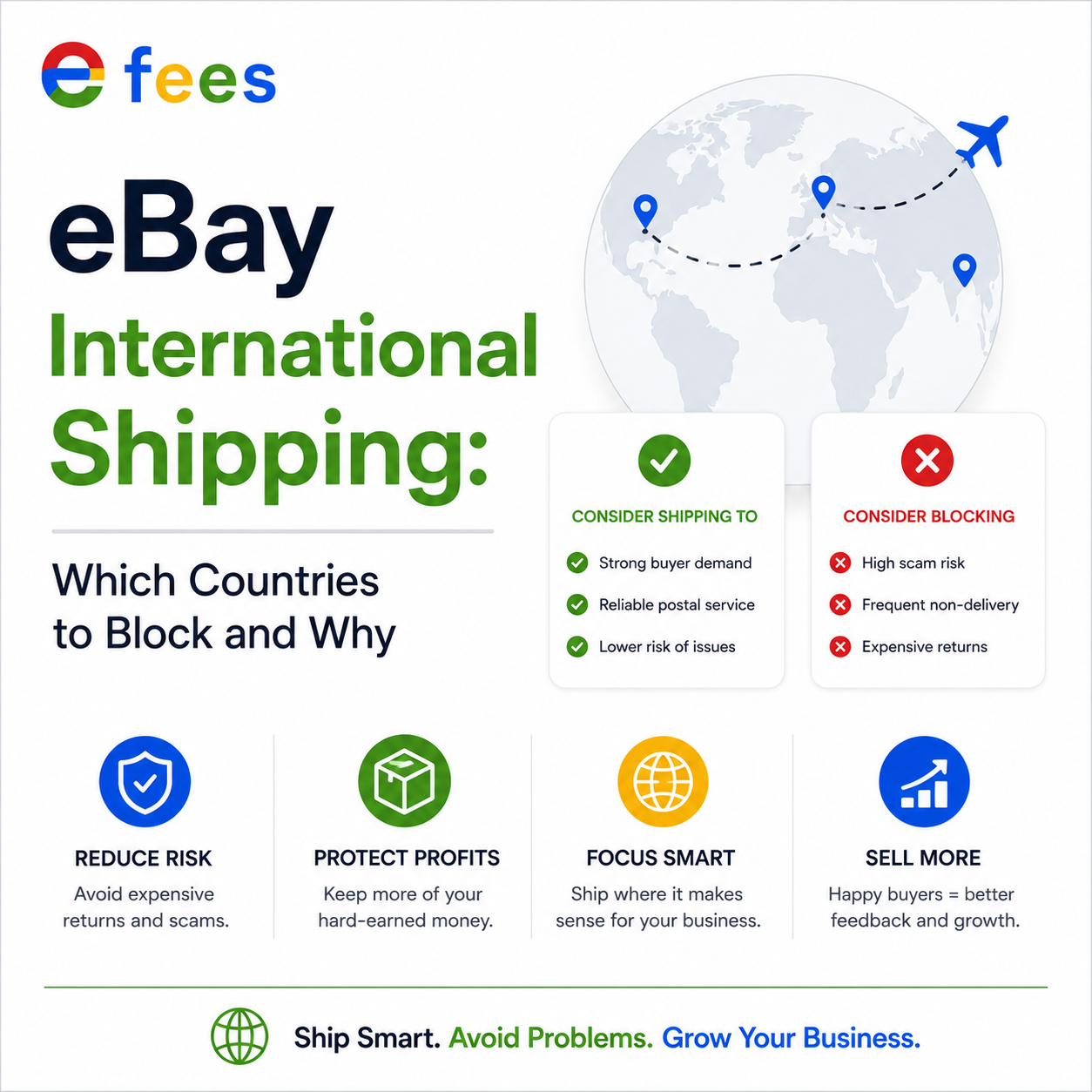
eBay International Shipping: The eBay International Shipping program is designed to simplify cross-border sales. Rather than dealing with customs forms and international carriers yourself, you ship the item to a domestic hub, and eBay handles the rest—customs paperwork, international delivery, buyer support, and returns. Buyers see one landed price at checkout with duties and taxes already included, which tends to mean fewer cancelled orders and fewer surprises on either side.
UK Seller Advantage: Private sellers in the United Kingdom receive an even better deal under the program. The extra international fee is waived entirely for private UK sellers, and eBay manages returns at no cost. This represents a meaningful removal of risk for smaller sellers, as international returns are often the factor that turns an overseas sale into a loss.
6. Strategies to Soften the Fee Impact on Shipping
There is no way around eBay charging a fee on the total sale—the fee is a fixed cost of selling on the platform. However, there are several strategies that can reduce the net impact on your profitability.
Build Shipping Into Your Price and Offer Free Shipping: The fee ends up the same either way, but free-shipping listings tend to perform better in search and often convert more buyers. By building the shipping cost into your item price, you maintain the same net while benefiting from improved search visibility and buyer preference.
Use eBay Labels: eBay Labels offer discounted rates for USPS, FedEx, and UPS compared to retail counter rates. A label that costs $8.50 through eBay Labels might cost $11 at the post office counter. This gap can meaningfully offset some of the fee burden, particularly for heavier or larger items.
Consider eBay International Shipping for Overseas Sales: Waived fees and managed returns, where available, can turn international sales from a gamble into something closer to predictable. The program also reduces your administrative burden, as eBay handles customs documentation and international delivery.
Bundle Items When It Makes Sense: The per-order fee applies once per sale, not once per item. Three books sold together for $30 trigger a single $0.40 fee, while the same three sold individually at $10 each rack up three separate $0.40 charges, totaling $1.20. Bundling saves on both the per-order fee and the shipping cost per item, as you pay one shipping label instead of three.
Monitor Carrier Rate Changes: When USPS, FedEx, or UPS raise rates and you pass that increase along to buyers, your eBay fee quietly rises with it. Adjusting your prices early—or deciding to absorb part of an increase to stay competitive—beats finding out after the fact when your margins have already been compressed.
7. Understanding Your Payout Statement
Once a sale settles, Seller Hub provides a detailed breakdown of exactly where your money went. The statement shows the total buyer payment, the final value fee calculated on that total, the per-order fee, any international fee if applicable, and—if you used eBay Labels—the label cost.
Payout Timing: Payouts typically go out within two business days of the buyer's payment clearing. If your balance for a given period does not cover your fees and label costs, eBay will charge your backup payment method within 14 days. This is why maintaining a valid credit or debit card on file is essential—even if you have sufficient balance to cover fees, the card serves as a backup in case of shortfalls.
Fee Review: Review your payout statements regularly to ensure accuracy. While eBay's fee calculation is automated and generally reliable, errors can occur, particularly with international transactions or items listed in categories with different fee structures.
FAQ:
Do eBay's final value fees include the shipping charge I collect from the buyer?
Yes. The fee is calculated on the buyer's total payment—item price, shipping and handling, and any applicable sales tax—regardless of whether shipping is charged separately or built into the item price.
How are shipping label costs paid—does eBay take that out automatically?
If you buy your label through eBay Labels, the postage cost is deducted from your payout along with eBay's fees. If you buy postage elsewhere, you pay the carrier directly, separate from your eBay payout. Either way, the final value fee is still based on the full amount the buyer paid, including shipping.
What are the typical eBay fees per order in 2026?
For most categories, the final value fee is 13.6% of the buyer's total payment (item plus shipping and tax) plus a flat per-order fee—$0.30 for orders of $10 or less, $0.40 above that. On a $50 total, this works out to $6.80 plus $0.40, or $7.20.
How can I estimate shipping accurately so fees and postage don't eat my profit?
Use eBay's built-in shipping calculator when listing—enter weight, dimensions, and carrier to see rates based on the buyer's location. For sharper accuracy, check third-party multi-carrier tools, and factor in packaging, handling time, and dimensional weight surcharges. Rates change often enough that it is worth revisiting every quarter.
How does eBay International Shipping affect my fees?
Cross-border sales carry an additional fee, approximately 1.65% for US sellers—on top of the standard final value fee. In exchange, eBay International Shipping handles customs, delivery, and returns once you ship to a domestic hub. Private UK sellers receive the international fee waived entirely, with returns managed at no extra cost.
Does offering free shipping reduce my eBay fees?
No. The fee is calculated on the total buyer payment regardless of whether shipping is itemized separately or built into the price. A $50 item with free shipping and a $40 item with $10 shipping generate the same eBay fee, because the total is the same in both cases.

eFee Editorial Team
The eFee Editorial Team publishes research-driven content to help eBay sellers better understand marketplace fees, pricing strategies, shipping costs and profitability. Our articles are regularly updated to reflect the latest eBay fee structures and seller best practices.
Reviewed periodically to reflect the latest eBay marketplace fee updates.
Was this article helpful?
Your feedback helps us improve future articles.