eBay Just Bought Depop for $1.2 Billion. Here's What It Actually Means for Resellers
eBay just bought Depop for $1.2 billion after Etsy took a $400 million loss on it. The promise is cross-listing and younger buyers, but Depop's broken offer system and brutal fee structure are what actually need fixing. Here's what resellers on both platforms should watch for — and why you shouldn't change your strategy yet.
Calculate Your eBay Selling Fees
Our free eBay Fee Calculator automatically calculates final value fees, promoted listing fees, international fees, regulatory fees, store subscription discounts, and different category-specific fee structures. See your estimated eBay fees, profit, and profit margin in seconds before you list.
Open Free eBay CalculatoreBay Acquires Depop: Analysis of the $1.2 Billion Fashion Resale Acquisition
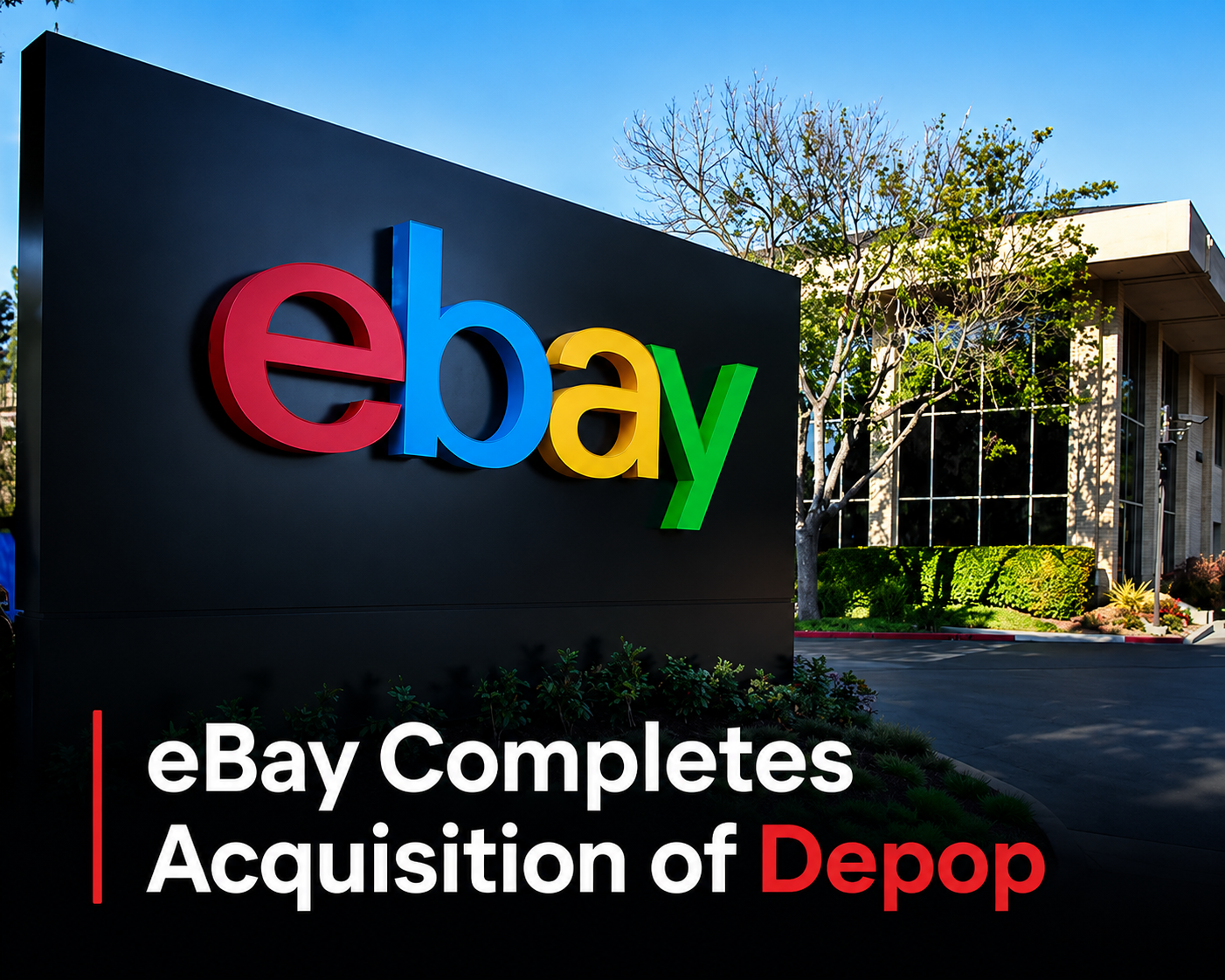
In February of this year, eBay wrote a check that made the entire resale industry take notice: $1.2 billion for Depop, a platform that Etsy had purchased just four years earlier for $1.6 billion, watched struggle under its ownership, and ultimately sold at a $400 million loss. The deal cleared regulatory hurdles in the United States and Germany, survived a UK Competition and Markets Authority review, and officially closed in August 2026. Depop is now eBay's.
For resellers operating on either platform, the question is not whether this matters—it is whether eBay will actually do something useful with the acquisition, or whether this is simply another corporate shuffle that changes nothing about your daily operations. This guide provides a structured, data-driven analysis of the acquisition, its implications for sellers, and what you should watch for as integration unfolds.
Key Takeaways
- eBay acquired Depop for $1.2 billion after Etsy sold it at a $400 million loss. The acquisition is primarily about demographics—90% of Depop's buyers are under 34, while eBay's user base skews older.
- No immediate changes for sellers. Depop will retain its name, brand, and culture for now. Your existing listings and workflows remain unchanged.
- Cross-listing opportunities are promised but undated. eBay has announced plans to integrate inventory visibility, but no timeline has been provided. Until there is a real tool, treat it as a headline, not a strategy.
- Depop has operational problems eBay could fix. Non-binding offers, confusing fees, and poor shipping infrastructure are long-standing seller complaints. If eBay addresses these, the platform could become more seller-friendly.
- The competitive landscape matters. Vinted's expansion, including into the US, is a direct challenge. eBay's acquisition of Depop is a defensive move to build a fashion resale portfolio.
- Audit your prices immediately. Depop buyers pay for aesthetic and curation; eBay buyers hunt for deals. The same item should be priced and presented differently on each platform.
- Watch for product announcements. Integration timelines, fee changes, and cross-listing tools will determine whether this acquisition benefits sellers or remains a corporate shuffle that changes nothing about your daily operations.
1. The Backstory: What Already Happened
Etsy acquired Depop in 2021 for $1.6 billion, at a time when resale marketplace valuations were at their peak and the industry believed Gen Z fashion resale was the next major growth opportunity. The logic was sound on paper: Etsy wanted younger buyers, and Depop had them. Etsy wanted fashion, and Depop was fashion. Combining them would create a secondhand empire spanning crafts, vintage, and contemporary fashion.
However, that vision did not materialize as expected. Depop continued to operate as its own entity with its own app, culture, and operational challenges. Under Etsy's ownership, Depop grew its gross merchandise sales to approximately $1 billion by 2025, including nearly 60% year-over-year growth in the United States. These numbers appear impressive until you consider that Depop's margins were actively dragging down Etsy's overall financial performance—specifically, a 350 basis point hit to Etsy's overall EBITDA. Depop was growing, but it was growing expensively.
Facing competitive pressures from Temu and Shein, Etsy decided to cut its losses and refocus on its core marketplace. The $1.2 billion sale represented a $400 million loss on their original investment, signaling that Etsy's strategic bet on Depop had not paid off as anticipated.
2. Why eBay Bought Depop: Demographics and Infrastructure
For eBay, the acquisition is fundamentally about demographics and category expansion. Fashion already generates more than $10 billion in annual gross merchandise volume for eBay, and it grew 10% year-over-year in the United States in 2025. However, eBay's user base skews older. Depop's does not—90% of Depop's seven million active buyers are under 34.
That demographic is one eBay has been trying to reach for years through partnerships, fashion week events, and collaborations with Vogue. Buying Depop is the most direct way to acquire that audience in bulk, bypassing the slow process of organic user acquisition.
Additionally, Depop brings a mobile-first, app-native fashion resale platform with a strong community culture. eBay has historically struggled to attract younger, fashion-focused buyers who prefer app-based, visually driven shopping experiences. Depop fills that gap immediately.
3. What eBay Has Announced for Depop
eBay has publicly stated its plans to expand Depop's inventory visibility through cross-listing opportunities. This corporate language translates to: Depop listings might eventually appear on eBay, and eBay listings might gain exposure to Depop's younger buyer base.
eBay also plans to bring its infrastructure to Depop, including shipping solutions, financial services, and Authenticity Guarantee for higher-end fashion items. These are areas where Depop has historically been weak, and eBay's operational strength could provide meaningful improvements.
The Depop Problem:
Depop has real operational problems that sellers have been complaining about for years. The fee structure is confusing and expensive. By the time you factor in selling fees, sales tax, and shipping, a $20 item can cost a buyer $40 or $50 at checkout. This pricing opacity forces sellers to race to the bottom on listed prices, which erodes margins and makes profitability difficult.
Depop's offer system is non-binding because the platform allows users under 18. This means buyers can make offers with no obligation to follow through. Sellers report accepting a dozen offers on a single item and completing zero actual transactions. The platform has cultivated a browsing culture that does not convert well to sales, frustrating sellers who spend time negotiating with unserious buyers.
The eBay Advantage:
eBay, despite its own flaws, knows how to facilitate transactions. It has been running marketplaces since 1995 and has mature systems for offer management, payment processing, and shipping. If eBay makes Depop's offers binding, stabilizes the fee structure, and brings legitimate shipping infrastructure to the platform, the entire seller experience could improve dramatically. Depop would retain its audience and aesthetic while gaining the operational backbone it has never had.
4. What This Means for Resellers
Immediate Impact:
For resellers, the immediate impact is minimal. eBay has stated that Depop will retain its name, brand, platform, and culture. There are no immediate changes for users. Your existing listings, workflows, and buyer relationships remain unchanged.
Long-Term Implications:
The long-term implications, however, are significant. If cross-listing becomes seamless, sellers who currently maintain separate inventories on eBay and Depop could eventually manage both from one dashboard. This would reduce operational overhead and make multi-platform selling more efficient.
If Depop's audience is exposed to eBay's fashion inventory, sellers with curated vintage or streetwear could see new demand from a younger, fashion-focused buyer base. And if eBay's Authenticity Guarantee extends to Depop, higher-end fashion sellers gain a trust signal that Depop has never had, potentially enabling higher price points.
The Risk Factors:
There is also risk. eBay has a history of acquiring companies and failing to integrate them meaningfully. The acquisition could end up being a $1.2 billion audience purchase that never translates into better tools for sellers.
Depop's community is fiercely protective of its culture. If eBay tries to make Depop look too much like eBay, the users might leave. The platform's appeal is its distinct, app-native, community-driven vibe. Over-corporatization could alienate the very users eBay paid to acquire.
If the cross-listing integration is clunky or delayed, sellers will simply continue doing what they are already doing: manually listing on both platforms, maintaining separate workflows, and treating the acquisition as background noise.
5. The Competitive Landscape
The competitive angle is worth watching. Vinted has been expanding aggressively, including into the US market, with its no-selling-fee model that undercuts both eBay and Depop on cost. eBay's acquisition of Depop, alongside its earlier acquisition of Tise in the Nordics, is clearly a defensive move to build a portfolio of fashion resale platforms that can compete with Vinted's pricing advantage.
Whether that strategy works depends on whether eBay can actually improve Depop's seller experience, not just its buyer numbers. Acquiring users is one thing; retaining them with a superior platform experience is another entirely.
6. What Sellers Should Do Now
Don't Change Anything Yet.
Keep listing on both platforms if that is your current strategy. Price for each platform's audience separately, as they serve different buyer demographics with different expectations.
Audit Your Prices Immediately.
The one thing you should do right now is audit your Depop prices against your eBay prices. If they are the same, you are probably doing it wrong. Depop buyers pay for aesthetic and curation. eBay buyers hunt for deals and specifics. The same vintage jacket should be presented differently, priced differently, and described differently on each platform. An acquisition does not change that fundamental truth.
Watch for Product Announcements.
The press release promised cross-listing opportunities, but no date is attached to that promise. Until there is a real tool available, it is just a headline. Monitor eBay's seller announcements and Depop's communication channels for actual integration timelines.
7. The Bottom Line
eBay bought Depop because it was concerned about becoming irrelevant to young fashion buyers. That fear was justified—the company's user base skews older, and Gen Z shopping behavior is increasingly mobile-first and app-driven.
Whether the purchase fixes the problem is a completely different question. And whether it fixes anything for your specific business is a question only time, and eBay's product team, can answer.
For now, treat the acquisition as a signal of eBay's strategic direction rather than an immediate operational change. Continue optimizing your listings for each platform individually, watch for integration announcements, and adjust your strategy only when there is a tangible tool or policy change to respond to.
Q&A:
Question: Will Depop and eBay merge into a single platform?
Short answer: Not in the foreseeable future. eBay has stated that Depop will retain its name, brand, platform, and culture. The platforms will likely remain separate with cross-listing integration rather than a full merger.
Question: Will my Depop listings automatically appear on eBay?
Short answer: Not automatically. eBay has announced plans to expand Depop's inventory visibility through cross-listing opportunities, but this requires product development and seller opt-in. No timeline has been provided for implementation.
Question: Should I change my pricing strategy on Depop now that eBay owns it?
Short answer: Not yet. Depop buyers and eBay buyers remain different audiences with different expectations. Continue pricing for each platform separately until integration creates actual changes in buyer behavior or cross-listing tools.
Question: How will eBay's Authenticity Guarantee affect Depop?
Short answer: eBay plans to bring Authenticity Guarantee to Depop for higher-end fashion items. If implemented, this could provide a trust signal that Depop has never had, potentially enabling higher price points for authenticated items.
Question: Will eBay's acquisition make Depop fees lower or more transparent?
Short answer: Possibly, but no changes have been announced. eBay has historically had a more transparent fee structure than Depop, but whether that transparency extends to Depop remains to be seen. Watch for announcements regarding fee structure changes.
eFee Editorial Team
The eFee Editorial Team publishes research-driven content to help eBay sellers better understand marketplace fees, pricing strategies, shipping costs and profitability. Our articles are regularly updated to reflect the latest eBay fee structures and seller best practices.
Reviewed periodically to reflect the latest eBay marketplace fee updates.
Was this article helpful?
Your feedback helps us improve future articles.