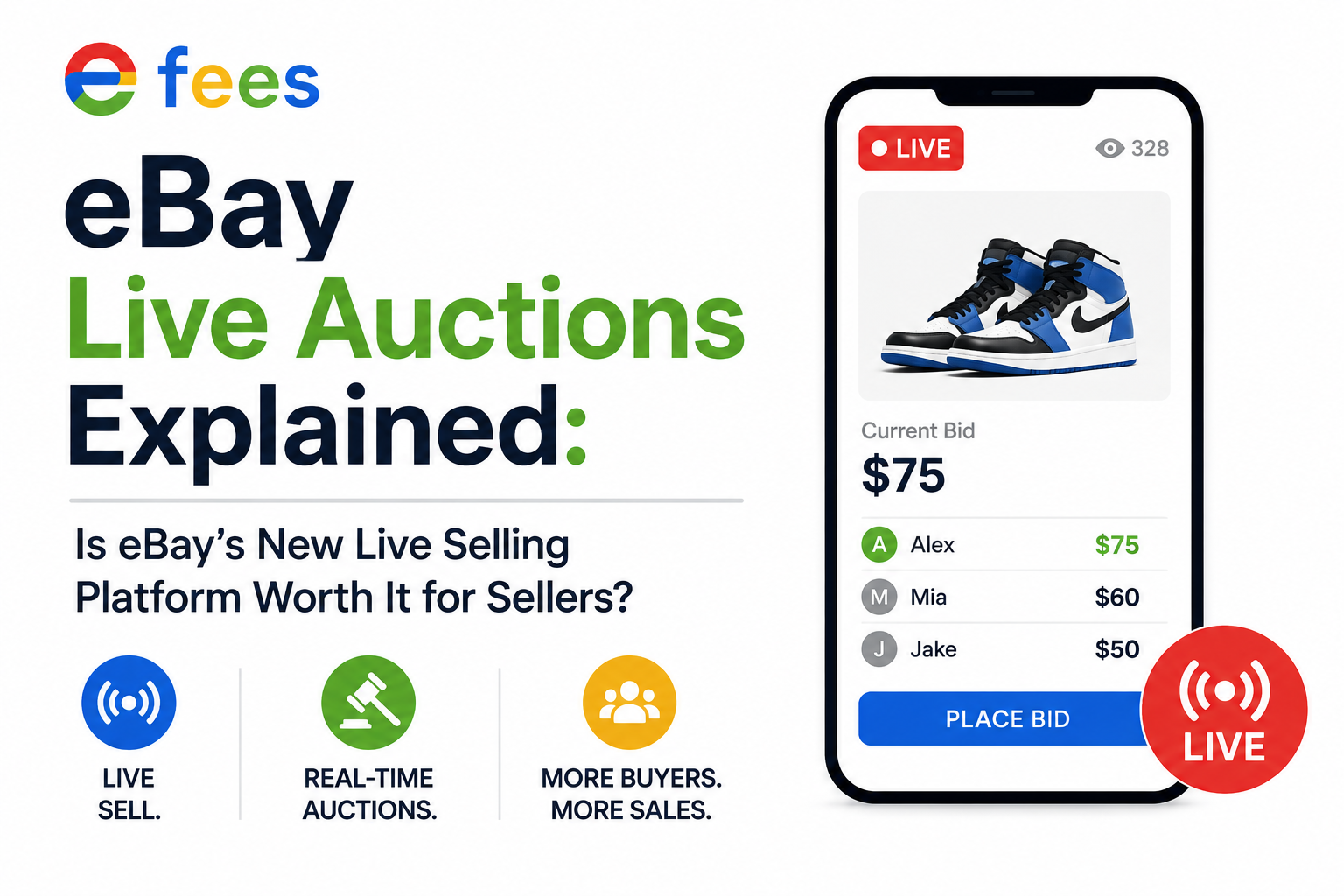
eBay Live Auctions Explained: Is eBay's New Live Selling Platform Worth It for Sellers?
Thinking about selling on eBay Live? Discover how eBay's live auction platform works, who can join, the biggest setup challenges, streaming requirements, fees, and expert tips to help you decide if eBay Live is the right selling strategy for your business.
Calculate Your eBay Selling Fees
Our free eBay Fee Calculator automatically calculates final value fees, promoted listing fees, international fees, regulatory fees, store subscription discounts, and different category-specific fee structures. See your estimated eBay fees, profit, and profit margin in seconds before you list.
Open Free eBay CalculatoreBay Live: A Guide to Live Commerce for Resellers
Live shopping is everywhere right now. TikTok Shop is moving billions. Whatnot turned trading cards into a spectator sport. Amazon and Facebook both have live streams where someone holds up a blender and thirty people buy it in real time. So of course eBay looked at that and thought: we should do that too.
Enter eBay Live. It's a live-stream shopping platform built directly into the app, letting approved sellers host real-time auctions, demo products on camera, answer viewer questions, and basically turn their inventory into a QVC segment. On paper, it's exciting. Urgency drives bidding. Personality builds trust. You can move slow inventory in twenty minutes instead of watching it sit for three months. But the gap between "exciting on paper" and "actually doing it" is massive, and most sellers who dive in discover that eBay Live demands skills they never signed up for.
This guide provides a structured, data-driven analysis of eBay Live, its requirements, its challenges, and whether it's worth your time and energy as a reseller.
Key Takeaways
- eBay Live is a live-stream shopping platform built into the app. Approved sellers host real-time auctions, demo products, and answer viewer questions.
- Eligibility is limited. You need a business account, good seller metrics, policy compliance, and an approved application. Casual sellers are locked out.
- The technical setup is more complex than regular listing. It's a multi-screen operation—laptop, tablet, phone. iPhone users have an easier time. Advanced streaming requires OBS Studio.
- The performative challenge is the real hurdle. Buyers evaluate you, not just the item. If you're comfortable on camera, this is an opportunity. If you're not, it's a wall.
- Copyright rules are strict. No commercial music in the background. Royalty-free tracks only. A silent room with someone talking feels awkward.
- The upsides: recorded streams and faster payment. Every stream is recorded, so disputes have a paper trail. Winning bidders pay within a tighter window.
- Live auctions work for specific inventory. Collectibles, vintage goods, sneakers, trading cards, slow-moving inventory, seasonal overflow.
- It's an additional channel, not a replacement. The sellers doing well still maintain traditional listings. They use live events to move specific inventory, build a following, and add personality to their brand.
- SEO still matters. Event titles, descriptions, and hashtags determine discoverability. Specific titles pull in the right audience. Vague titles get buried.
- Try it with low-stakes inventory. Do one stream with items you don't care deeply about. See if it works for you. Don't bet your business on it, but don't ignore it either.
1. What eBay Live Actually Is?
eBay Live lets approved sellers broadcast live video directly to buyers. During a stream, you can show a product from every angle, launch a timed auction, take questions in real time, and sell multiple items in a single session. It's meant to recreate the energy of an auction house or an estate sale, where the crowd and the competition push prices higher.
The Ideal Categories:
For collectibles, vintage goods, sneakers, trading cards—categories where condition details matter and buyer trust is everything—this format actually makes sense. A photo can hide a flaw. A live camera under good lighting can't.
2. The First Wall: Eligibility and Approval
Not everyone gets to do this. eBay Live requires a business account, good seller performance metrics, compliance with their policies, and an application that eBay has to approve. Casual sellers and hobbyists are locked out.
The Rationale:
For eBay, this is quality control. They don't want someone's first live event to be a disaster that goes viral for the wrong reasons. For you, it means if you're selling part-time under a personal account, this isn't even an option yet.
The Application Process:
The application requires you to demonstrate that you have a legitimate business presence, good seller metrics (Above Standard or Top Rated), and inventory that would benefit from live demonstration. If you're a casual seller, you're not eligible.
3. The Technical Setup: More Complex Than Listing
If you do get approved, prepare for a setup process that's more complicated than most listing workflows. Creating a live event isn't a matter of hitting "Go Live" and pointing your phone at a shoe. You're navigating multiple menus, configuring auction drafts, setting shipping options, prepping inventory to feature, and figuring out how the live interface talks to your existing listings.
The Multi-Screen Reality:
Sellers who run their entire business from a smartphone often find themselves needing a laptop open nearby, a tablet for monitoring comments, and their phone for the actual camera. It's a multi-screen operation, and if you're used to listing an item in three minutes flat, this feels like building a spaceship.
Device Compatibility:
Your device matters more than it should. iPhone users generally have an easier time because eBay's live tools integrate more cleanly with iOS. Android users hit more friction, and if you want anything resembling a professional stream—stable camera, good audio, overlays, multiple angles—you'll likely need third-party broadcasting software like OBS Studio.
The OBS Learning Curve:
OBS is powerful. It's also what Twitch streamers use, and learning it is a whole separate hobby. If you're already comfortable with video production, this is a minor hurdle. If your technical expertise stops at "I know how to retake a photo when the lighting is bad," OBS is a wall.
4. The Performative Challenge
The real challenge isn't technical. It's performative. Traditional eBay selling is asynchronous. You take photos, write a description, set a price, and walk away. The product sells itself while you sleep. eBay Live puts you at the center of the transaction.
The Evaluation Shift:
Buyers aren't just evaluating the item. They're evaluating you. Your energy, your knowledge, your ability to answer questions without stumbling, your willingness to perform for an audience that might be two people or two hundred.
The Personality Fit:
Some sellers love this. They thrive on the interaction, the banter, the immediate feedback. Others discover that being on camera is exhausting, that their natural speaking voice sounds weird to them, and that twenty minutes of live selling drains more energy than a full day of packing orders.
5. The Copyright Trap
The copyright trap is something nobody warns you about. You can't just throw on a Spotify playlist in the background. eBay Live enforces copyright rules strictly, and using commercial music without permission can get your stream pulled or worse.
The Solution:
If you want audio, it's royalty-free tracks or nothing. That might sound minor until you're sitting in a silent room trying to hype up a vintage watch and realizing how dead the air feels without something playing.
6. The Upsides: Protection and Payment Speed
On the upside, the protections are solid. Every stream is recorded, which means disputes about condition or what was actually shown have a paper trail. eBay's existing buyer and seller protection framework still applies, so non-paying bidders and fraudulent behavior are handled the same way they would be in a regular auction.
Payment Speed:
Payment is also faster. Winning bidders are expected to pay within a tighter window, which means less of the "I won but I'm not paying" nonsense that plagues traditional auctions. You can ship sooner, cash hits your account sooner, and the whole cycle compresses.
7. When Live Auctions Actually Work
For the right inventory, live auctions can genuinely work. Slow-moving collectibles, seasonal overflow, items where condition is hard to capture in photos—these are perfect for live selling.
The Engagement Advantage:
Instead of hoping the right buyer stumbles across your listing in search, you're putting the item directly in front of an audience that's already watching, already engaged, and already in the mood to buy. Even a modest stream with twenty active viewers can generate more competitive bidding than a month of passive listing.
The Channel Relationship:
But it's an additional channel, not a replacement. The sellers doing well with eBay Live still maintain their traditional listings. They use live events to move specific inventory, build a following, and add personality to their brand. They don't abandon search optimization for the thrill of the camera.
8. Discoverability and SEO
Discoverability works similarly to regular listings, which means SEO still matters. Your event title, description, and hashtags determine whether anyone finds your stream.
The Title Difference:
A vague title like "Cool Vintage Stuff" gets buried. Something specific like "Live Estate Sale Auction: Mid-Century Furniture & Art Glass" pulls in the right audience. The buyers who show up because they're genuinely interested in your niche are the ones who bid. Random traffic just watches and leaves.
9. Is It Worth It?
That depends entirely on who you are. If you're comfortable on camera, you have inventory that benefits from demonstration, and you don't mind the technical setup, eBay Live is a legitimate new revenue stream. It can move dead stock, build customer loyalty, and differentiate you from the thousands of faceless listings competing for the same search terms.
The Warning:
But if the thought of performing for an audience makes you anxious, if your inventory is mostly commodity items that don't need explanation, or if you're already stretched thin managing your existing listings, this might be more distraction than opportunity.
10. The Bottom Line
Live commerce isn't going away. If anything, it's going to get bigger, and eBay will likely expand access and simplify the tools over time. Getting in early has advantages—less competition for viewer attention, more room to establish yourself as a host buyers trust. But getting in early also means dealing with rough edges, unclear workflows, and the learning curve of a platform that's still figuring itself out.
The Recommendation:
If you're curious, apply. Get approved. Do one stream with inventory you don't care deeply about, so the stakes are low. See how it feels. See if your audience shows up. See if the bids justify the time and energy. Don't bet your business on it, but don't ignore it either. The sellers who adapt to new formats are usually the ones still standing when the old formats stop working.
Q&A:
Question: What is eBay Live?
Short answer: A live-stream shopping platform built into the eBay app. Approved sellers can host real-time auctions, demo products on camera, answer viewer questions, and sell multiple items in a single session.
Question: Who is eligible to use eBay Live?
Short answer: Sellers with business accounts, good seller performance metrics (Above Standard or Top Rated), compliance with eBay policies, and an approved application. Casual sellers and hobbyists are not eligible.
Question: What technical setup is required?
Short answer: More than you'd expect. It's a multi-screen operation—laptop for setup, tablet for monitoring comments, phone for the camera. iPhone users generally have an easier time. Advanced streaming requires OBS Studio.
Question: What is the biggest challenge of eBay Live?
Short answer: The performative element. Traditional eBay selling is asynchronous. Live selling puts you at the center of the transaction. Buyers are evaluating you, not just the item. Some sellers thrive on this; others find it exhausting.
Question: What types of inventory work best for eBay Live?
Short answer: Collectibles, vintage goods, sneakers, trading cards—categories where condition matters and live demonstration provides value. Slow-moving inventory and seasonal overflow are also good candidates.
Question: Is eBay Live worth the effort?
Short answer: It depends. If you're comfortable on camera, have inventory that benefits from demonstration, and don't mind the setup, it can be a legitimate new revenue stream. If you're camera-shy or stretched thin on existing listings, it might be more distraction than opportunity.
eFee Editorial Team
The eFee Editorial Team publishes research-driven content to help eBay sellers better understand marketplace fees, pricing strategies, shipping costs and profitability. Our articles are regularly updated to reflect the latest eBay fee structures and seller best practices.
Reviewed periodically to reflect the latest eBay marketplace fee updates.
Was this article helpful?
Your feedback helps us improve future articles.