
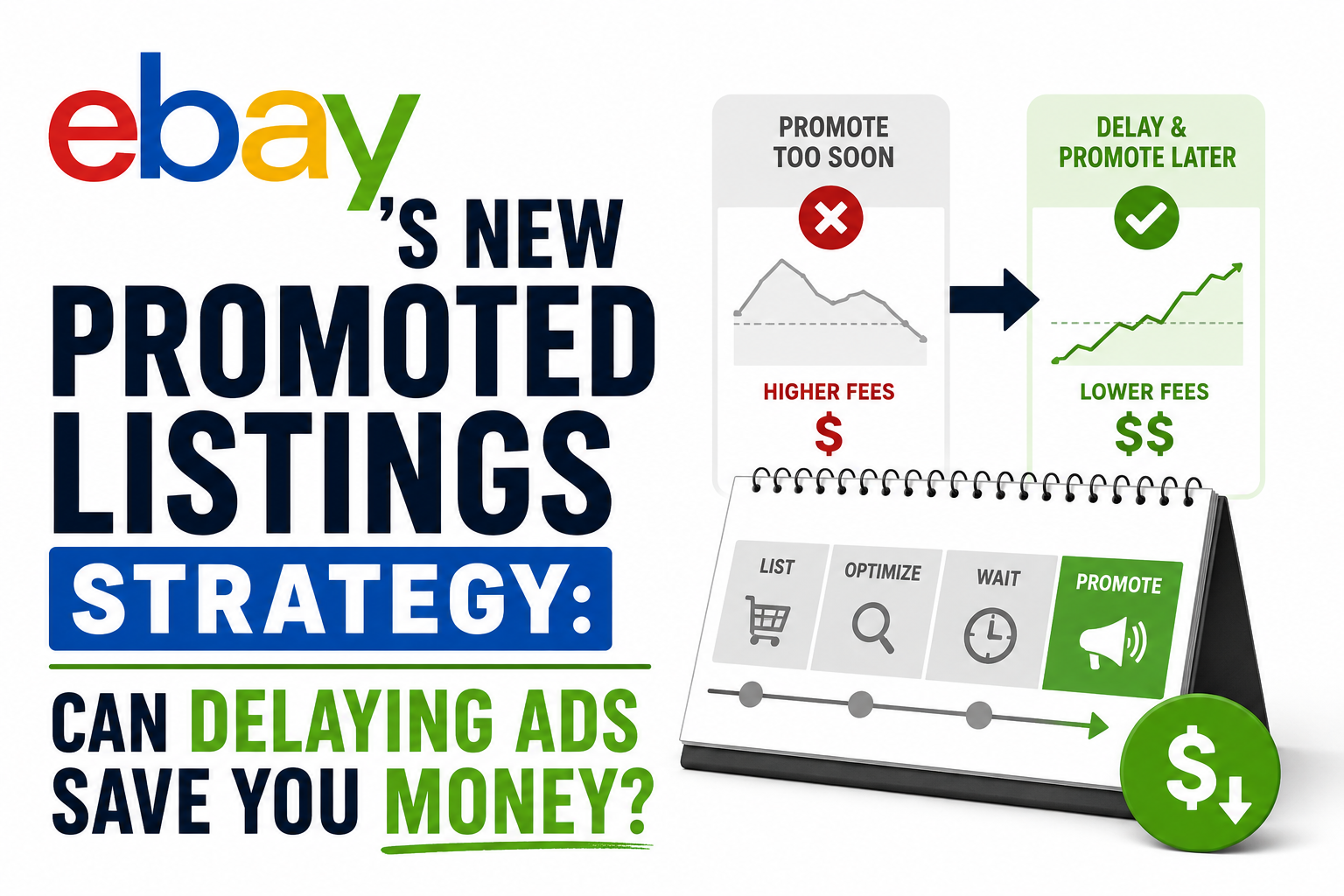
eBay’s New Promoted Listings Strategy: Can Delaying Ads Save You Money?
eBay’s January attribution update changed how Promoted Listings fees work. Here’s why many sellers are delaying promotions—and whether the strategy actually pays off.
Calculate Your eBay Selling Fees
Our free eBay Fee Calculator automatically calculates final value fees, promoted listing fees, international fees, regulatory fees, store subscription discounts, and different category-specific fee structures. See your estimated eBay fees, profit, and profit margin in seconds before you list.
Open Free eBay CalculatoreBay's Promoted Listings Attribution Change: A Guide to the New Economics of eBay Advertising
If you've been running eBay Promoted Listings the same way for the last few years—flipping the switch on every new listing, setting a flat ad rate between two and five percent, and letting the algorithm handle the rest—there's a change from January 13 that you need to know about. It's not a price hike. It's not a new feature. It's a fundamental rewrite of when you actually pay for ads, and it's making a lot of sellers' advertising bills balloon without them realizing why.
For years, Promoted Listings Standard worked the way you'd expect. A buyer clicks your ad, that same buyer later purchases the item, and you pay the agreed advertising fee. Clean. Logical. You only paid when the ad clearly generated the sale. But on January 13, eBay rolled out a new attribution model that works very differently, and the reseller communities figured it out pretty quickly because their ad costs started climbing for no obvious reason.
This guide provides a structured, data-driven analysis of the attribution change, its impact on seller economics, and practical strategies for adapting your advertising strategy.
Key Takeaways
- eBay changed the Promoted Listings attribution model on January 13, 2026. A single click now opens a thirty-day window. Any sale within that window triggers the ad fee—even if the buyer never saw the ad.
- Attribution rates have skyrocketed. Before January, roughly half of promoted sales generated fees. After, some sellers report ninety-one percent of promoted sales triggering fees. You're now paying on sales that would have happened organically.
- Delayed promotion is gaining traction. Let listings sit organic for thirty days. If they sell, zero ad cost. If they don't, promote them. One seller saved roughly $299 over two months with no drop in sales volume.
- It doesn't work for everyone. Saturated categories, high competition, and certain inventory types may still require immediate promotion. Test it with your own numbers.
- Promoted Listings is no longer set-it-and-forget-it. It's a strategic investment. Ask: does this item actually need advertising, or will it sell on its own?
- Pull your Promoted Listings report. Look at your attribution rate. Count how many sales were charged to ads versus genuinely driven by them. If you're paying for organic sales, your strategy needs to change.
1. What Changed: The Thirty-Day Attribution Window
Under the new system, if anyone clicks your promoted listing, that single click opens a thirty-day attribution window. If any buyer—not the person who clicked, but literally any buyer—purchases that item within those thirty days, eBay charges you the advertising fee. Even if the person who actually bought it never saw your ad. Even if they found your listing through organic search, or through your store page, or by typing the item number directly into their browser.
The Implications:
The click from one person creates a fee trigger that any subsequent sale can trip. You promote a listing. Someone clicks it, maybe by accident, maybe out of curiosity, maybe because they were price-checking and had no intention to buy. Three weeks later, a completely different buyer finds your listing organically and purchases it. You still pay the ad fee.
eBay's Justification:
On paper, eBay is saying the promotion "influenced" the sale because it happened within the window. In practice, it means sellers are now paying for purchases that almost certainly would have happened for free.
2. The Numbers: What the Data Shows
The numbers back this up. Before January, roughly half of promoted sales resulted in an advertising charge under the old click-and-buy model. After the change, one reseller who tracked their data found that around ninety-one percent of promoted sales generated advertising fees. Ninety-one percent. That's not a tweak. That's a complete inversion of how the economics work.
The Seller Experience:
The change explains why so many sellers opened their February statements and felt a little sick. Ad bills climbed without any corresponding increase in sales. The attribution rate had shifted, and sellers were paying for ads on sales that would have happened organically.
3. The Natural Question: Is Immediate Promotion Still Worth It?
The natural question, then, is whether promoting every listing immediately still makes any sense. For a long time, the default advice was to promote everything from day one. It was easy, it was automatic, and under the old model the cost was contained because you only paid when ads actually drove the sale.
The New Reality:
Now, with nearly every sale triggering a fee, a lot of experienced sellers are asking a simpler question: why am I paying to advertise products that would have sold anyway? If the attribution window means you're paying on organic sales, the economics of advertising have fundamentally changed.
4. The Delayed Promotion Strategy
The question of immediate promotion has spawned a strategy that's gaining real traction in reseller circles. It's called delayed promotion, and it's exactly what it sounds like. Instead of flipping on Promoted Listings the moment a new item goes live, you let it sit for thirty days completely organic. No ads. No boosted placement. Just your title, your photos, and eBay's standard search algorithm.
The Logic:
If the item sells during that window, you pay zero in advertising. If it doesn't sell after thirty days, then and only then do you enable Promoted Listings at a competitive rate to give it a visibility push. The logic is straightforward. Products with real demand often sell quickly without any paid help. Trending items, popular brands, competitively priced inventory, collectibles with built-in search volume—these things get found. By letting them prove themselves organically first, you avoid paying fees on the easy wins and preserve your ad budget for the slow movers that actually need the boost.
The Data:
One seller put this to the test over about two months after the January change. They listed 272 items without immediate promotion, only enabling ads after the thirty-day organic period expired. Of those 272 sales, 114 sold organically before ever being promoted. The other 160 sold after promotions were activated. Total ad spend for the period was roughly $379. The seller estimated they saved about $299 by not paying for ads on those 114 organic sales. That's not pocket change. That's several hundred dollars every couple of months just by waiting a month before turning on the ads.
The Surprising Result:
Sales volume didn't drop. In fact, it stayed relatively stable and even ticked up slightly. Average selling prices were a bit lower, but that seemed to reflect the mix of inventory rather than any loss of visibility. The takeaway was clear: delaying promotions didn't hurt sales. It just stopped the seller from lighting money on fire.
5. When Delayed Promotion Doesn't Work
Delayed promotion isn't a universal solution. A seller moving common household goods in a saturated category might rely heavily on paid visibility from day one and see their sales crater without it. Someone selling rare trading cards or vintage streetwear might find that organic search does most of the heavy lifting regardless.
Variables That Matter:
Seasonality matters. Competition matters. Pricing matters. The only honest answer is that you have to test it yourself and look at your own numbers, because copying someone else's strategy without knowing your own data is just gambling with extra steps.
The Seller Divide:
The reseller communities are split on this, which is actually a good sign that the change is real and meaningful. Some sellers report lower ad costs and better margins after pulling back on promotions. Others say their attribution rates went through the roof and their visibility tanked when they cut spend. That divergence is exactly why you can't trust a one-size-fits-all answer. The sellers who are going to win this are the ones who treat advertising as a strategic decision rather than a default setting.
6. Automation and Tools
Automation helps if you're managing hundreds or thousands of listings. Several third-party tools can now identify stale inventory, automatically enable promotions after a set number of days, refresh listings, and adjust ad rates without you manually babysitting every item. If you're still toggling Promoted Listings by hand at scale, you're either a masochist or you've got way more free time than the rest of us.
7. Should You Stop Using Promoted Listings Entirely?
Probably not. In crowded categories where organic search is a blood sport, paid placement is still one of the few ways to get seen. But the question has changed.
The New Questions:
It used to be "Should I promote this?" Now it should be:
- Does this product actually need advertising?
- Is it likely to sell on its own?
- Would promotion be more valuable after the initial demand spike fades?
- Most importantly, will the ad cost still leave me with any profit after eBay takes its cut under this new attribution model?
Advertising on eBay is no longer a set-it-and-forget-it expense. It's a strategic investment that requires you to know your inventory, know your margins, and pay attention to whether you're paying for real visibility or just funding eBay's bottom line on sales you would have made for free.
8. The Bottom Line
The sellers who adapt to this—who test, who measure, who promote selectively instead of blindly—are the ones who will still be profitable six months from now. The ones who don't are going to keep wondering why their ad bills keep climbing while their actual sales stay flat.
Q&A:
Question: What changed with eBay Promoted Listings on January 13?
Short answer: eBay changed the attribution model. A single click on a promoted listing now opens a thirty-day attribution window. If any buyer purchases that item within thirty days, eBay charges the ad fee—even if the buyer who purchased never saw the ad. This means sellers are now paying for organic sales that happen within the attribution window.
Question: How much did ad costs increase?
Short answer: Before January, roughly half of promoted sales generated an ad fee under the old click-and-buy model. After the change, one reseller found that ninety-one percent of promoted sales generated fees. That's a complete inversion of the economics.
Question: What is the delayed promotion strategy?
Short answer: Instead of promoting new listings immediately, let them sit organic for thirty days. If they sell during that period, you pay zero in advertising. If they don't sell after thirty days, then enable promotions. One seller testing this saved roughly $299 over two months with no drop in sales volume.
Question: Does delayed promotion work for everyone?
Short answer: No. In saturated categories where organic search is difficult, immediate promotion may still be necessary. Seasonality, competition, and pricing all matter. You have to test it with your own inventory and your own numbers.
Question: Should I stop using Promoted Listings entirely?
Short answer: Probably not. In crowded categories, paid placement is still one of the few ways to get seen. But the question has changed from "Should I promote this?" to "Does this actually need advertising, or will it sell on its own?"
Question: What's the most important thing to do right now?
Short answer: Pull your Promoted Listings report from the last thirty days. Look at your attribution rate. Count how many sales were charged to ads versus how many felt genuinely driven by them. Then ask yourself if you're paying for performance, or just paying because eBay found a way to charge you for breathing near the search results.
eFee Editorial Team
The eFee Editorial Team publishes research-driven content to help eBay sellers better understand marketplace fees, pricing strategies, shipping costs and profitability. Our articles are regularly updated to reflect the latest eBay fee structures and seller best practices.
Reviewed periodically to reflect the latest eBay marketplace fee updates.
Was this article helpful?
Your feedback helps us improve future articles.