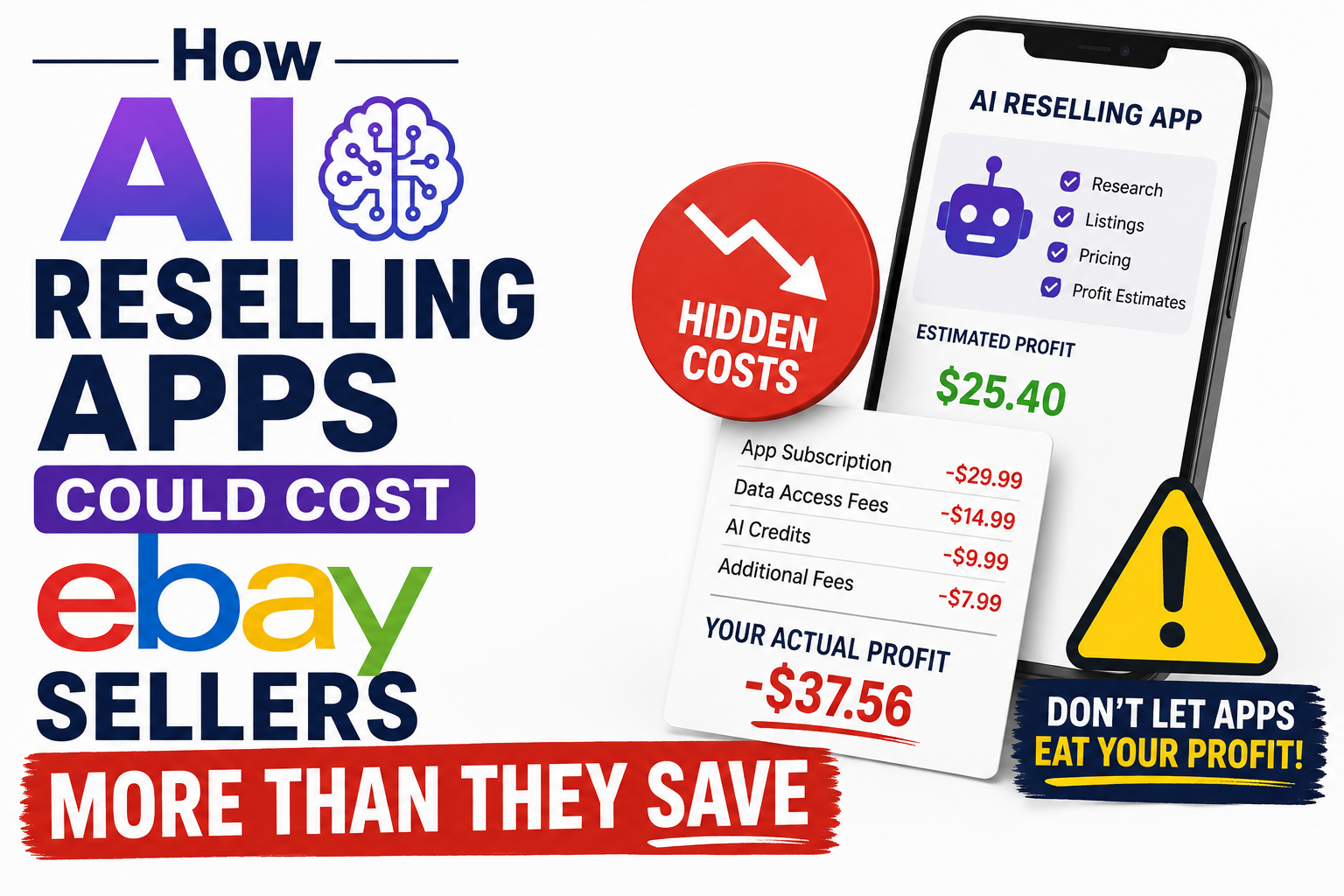
How AI Reselling Apps Could Cost eBay Sellers More Than They Save?
AI-powered reselling tools promise faster listings, smarter sourcing, and instant pricing—but are they actually helping sellers, or introducing new risks? Here's what every reseller should know before trusting AI with their business.
Calculate Your eBay Selling Fees
Our free eBay Fee Calculator automatically calculates final value fees, promoted listing fees, international fees, regulatory fees, store subscription discounts, and different category-specific fee structures. See your estimated eBay fees, profit, and profit margin in seconds before you list.
Open Free eBay CalculatorAI Reselling Apps Are Everywhere Right Now. Most of Them Are Lying to You.
Walk into any thrift store in America right now and you'll see them. Sellers standing in the aisles, phone in hand, scanning barcodes while an app tells them in real time whether that vintage jacket is worth fifteen dollars or fifty. Scroll through reseller Facebook groups and someone's always pitching a new tool that writes your eBay listings in ten seconds, removes backgrounds from your photos automatically, or predicts the next hot product before it trends. AI has officially arrived in reselling, and it showed up loud, confident, and wearing a really nice website.
But here's the problem nobody wants to talk about: a lot of these apps are built on hype, bad data, and the assumption that you won't notice when they're wrong. And when you're running a business where a single bad listing or an inaccurate price suggestion can cost you real money, "wrong" isn't a minor inconvenience. It's a profit leak. Or a return. Or a policy violation that gets your account dinged.
So let's cut through the marketing. Here's what's actually happening with AI in reselling, which tools are genuinely useful, which ones are digital snake oil, and how to tell the difference before you hand over your data, your photos, and your trust.
---
The reason there are suddenly five hundred AI reselling apps is simple: building software used to be hard. You needed developers, funding, months of coding, actual infrastructure. Now you can describe an app in plain English to an AI coding assistant and have a working prototype by lunch. This "vibe coding" revolution has made launching software so easy that people with zero reselling experience and a weekend of free time are shipping polished-looking tools that promise to automate your entire business.
And they look good. Really good. Modern AI design tools can spin up professional websites, slick dashboards, and convincing logos in hours. But a pretty interface doesn't mean the person behind it knows what a final value fee is. It doesn't mean their pricing data is accurate. It doesn't mean your uploaded product photos are secure. It just means they know how to make something look trustworthy. Appearance is no longer a reliable indicator of quality, and in the AI gold rush, a lot of sellers are learning that the hard way.
Most of these tools fall into three categories, and each one has a dirty secret.
AI listing generators are the most common. You upload a few photos, the app spits out a title, description, keywords, and item specifics in seconds. For anyone managing hundreds of listings, this sounds like a dream. But writing listings was never the hardest part of reselling. Pricing was. Researching demand was. Understanding whether the market for that item is hot or dead was. AI can write a beautiful description, but it often pulls pricing suggestions from incomplete data, active listings that haven't sold, or broad market averages that don't match your item's actual condition. The result? You overprice something that sits forever, or you underprice a valuable piece and leave money on the table because an app told you to.
AI photo tools are the second category, and these might be the most dangerous. They promise to remove backgrounds, drop your product into a gorgeous lifestyle scene, and make your listing look like it belongs on a brand website. Some of them work well. But there's a critical difference between enhancing a photo and generating a new one. Many AI image tools don't just clean up your picture—they recreate it based on what the AI thinks your product should look like. Scratches disappear. Colors shift slightly. Textures change. Sometimes accessories that aren't included in your item magically appear in the generated image. That might seem harmless until a buyer receives a sweater with a stain that was edited out, or a mug that doesn't match the "enhanced" photo because the AI changed the glaze. eBay requires your listing to accurately represent the item. An AI-generated image that misrepresents condition isn't a time-saver. It's a return waiting to happen. Or a policy violation. Or negative feedback that tanks your seller rating.
AI sourcing and pricing assistants are the third type, and they're everywhere right now. Point your camera at an item in a thrift store, the app scans it, and seconds later you're looking at an estimated resale value, demand score, and projected profit margin. It feels like magic. It feels like having a superpower. But the quality of that recommendation depends entirely on the data feeding the AI, and most third-party apps don't have direct access to complete eBay sold-listing data. They're working with incomplete datasets, active listings that may never sell, or broad market assumptions that don't account for seasonality, regional demand, or the specific flaws in the item you're holding. The app isn't lying to you. It just doesn't know what it doesn't know. And if you trust that $45 estimate on a piece that's actually worth $12, you just bought yourself a very small, very expensive lesson.
The deeper issue here is a misconception about what AI actually does. It doesn't know things. It predicts patterns based on the information it's fed. If that information is incomplete, outdated, or garbage, the output is garbage too. A successful reseller factors in condition, brand heat, seasonality, competition, shipping costs, and buyer behavior that shifts week to week. No AI tool has access to all of that context, especially if it's pulling from limited or third-party data sources. AI should complement your research, not replace it. Treating it like an all-knowing oracle is how you end up with a store full of overpriced inventory and a photo gallery that looks nothing like your actual items.
There's also the security question, which nobody wants to think about but everybody should. When you upload your product photos to an AI app, where do they go? Who stores them? Who has access? What happens to your data if the startup shuts down in six months, which a lot of them will? A beautiful dashboard doesn't answer any of those questions. Transparency should never be optional, but in the rush to ship features, a lot of these apps treat it like one.
And then there's the accountability problem. AI tools optimize for speed and automation. eBay optimizes for accuracy and trust. Those goals don't always align. An AI-generated listing might misidentify a product, suggest incorrect specifications, recommend a price based on fantasy data, or generate a photo that omits a flaw. When that happens, eBay doesn't care that an app made the mistake. You are responsible for your listings. Every single one. Using AI doesn't transfer that responsibility. It just adds a middleman between you and a potential policy violation.
Experience matters too, and not every AI app is built by people who have ever sold anything online. Some developers saw AI as a hot trend, went looking for a problem to solve, and landed on reselling because it seemed easy to automate. Others spent years in the trenches—sourcing, listing, dealing with returns, understanding buyer psychology—and then built software to solve the problems they actually lived through. That distinction is everything. The best tools come from teams that understand final value fees, inventory management workflows, shipping headaches, and the specific anxiety of watching a listing sit for ninety days with zero views. Technology alone can't replace that kind of practical knowledge.
Before you download the next shiny AI app that promises to revolutionize your business, ask five questions. Does it solve a real problem, or is it just using AI as a marketing buzzword? Where does its pricing data actually come from? Does it enhance your photos or recreate them entirely? Who built this, and do they have any actual reselling experience? And how is your data stored, protected, and potentially shared? If the app can't give you straight answers, don't give it your business.
None of this means AI is useless in reselling. It's not. Used properly, it's a genuine productivity multiplier. It can speed up repetitive tasks, organize information, generate ideas, and handle the grunt work that eats your time. But successful reselling still depends on human judgment. You recognize market trends before they show up in data. You evaluate condition with your hands and your eyes, not an algorithm. You understand buyer demand in ways that no AI can replicate consistently. The best approach is to let AI handle the boring stuff while you handle the decisions. When combined with research, experience, and a healthy skepticism, AI is a valuable assistant. When trusted blindly, it's an expensive mistake.
The future of AI in reselling is real, and a lot of these tools will get genuinely good as the technology matures. But right now, the market is flooded with apps that vary wildly in quality, accuracy, and reliability. Don't be impressed by a polished landing page or a slick demo video. Ask harder questions about data sources, image authenticity, security practices, and whether the people behind the product have ever stood in a Goodwill aisle at 8 AM wondering if a ceramic cat is worth anything.
The sellers who thrive in the AI era won't be the ones who automate everything. They'll be the ones who know which parts of their business deserve human judgment and which parts can safely be handed off to a machine. Be curious about AI, but don't be naive. Your business depends on it.
Now go audit the AI apps on your phone. Check their data sources. Read their privacy policies. And maybe delete the ones that promise to do your thinking for you.

eFee Editorial Team
The eFee Editorial Team publishes research-driven content to help eBay sellers better understand marketplace fees, pricing strategies, shipping costs and profitability. Our articles are regularly updated to reflect the latest eBay fee structures and seller best practices.
Reviewed periodically to reflect the latest eBay marketplace fee updates.
Was this article helpful?
Your feedback helps us improve future articles.