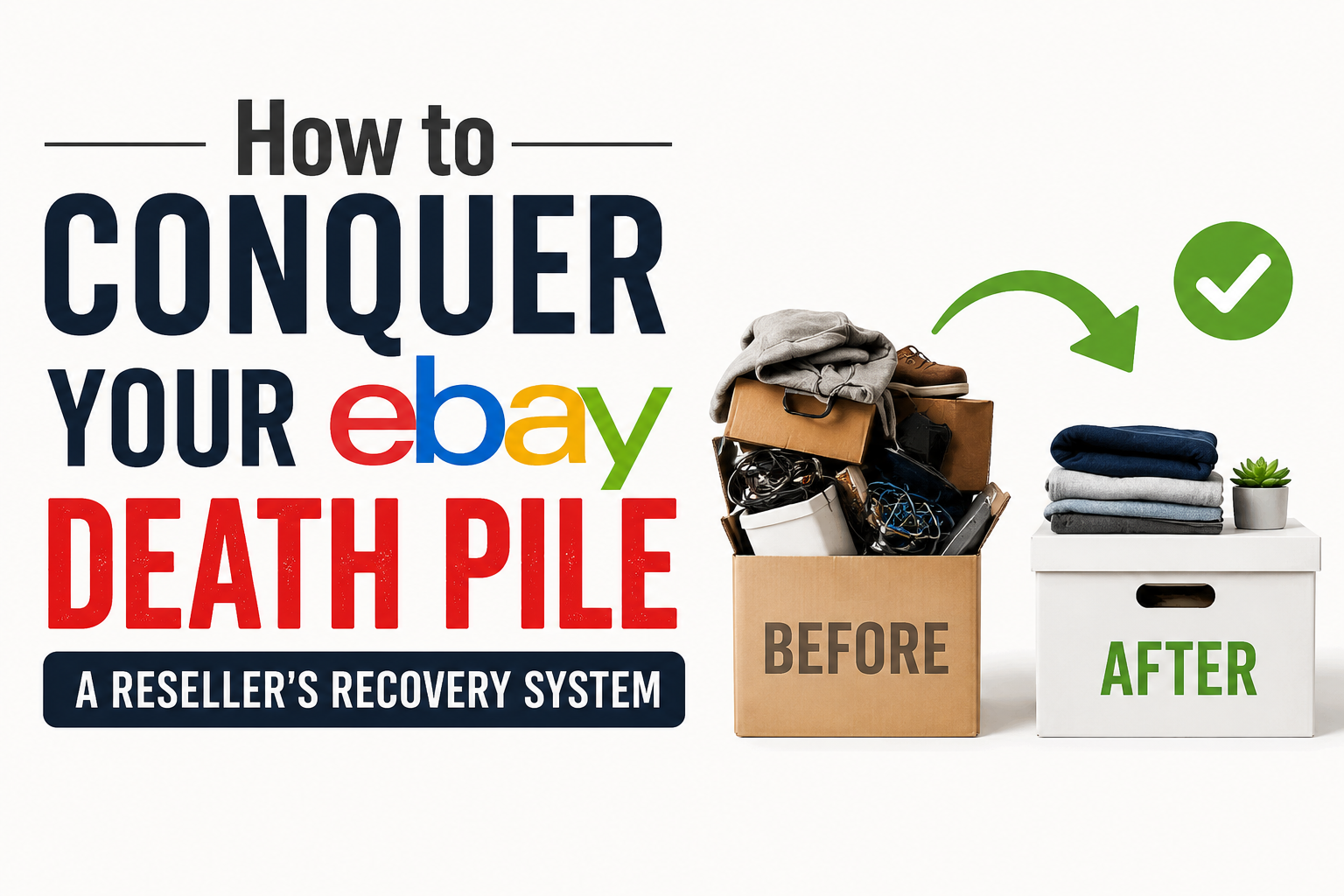
How to Conquer Your eBay Death Pile: A Reseller's Recovery System
That bin in the corner with LIST THIS WEEKEND written on it in Sharpie? It's August now. Here's a recovery system that treats your eBay death pile like what it actually is an emotional problem with a logistical fix and gets you listing again without the guilt spiral.
Calculate Your eBay Selling Fees
Our free eBay Fee Calculator automatically calculates final value fees, promoted listing fees, international fees, regulatory fees, store subscription discounts, and different category-specific fee structures. See your estimated eBay fees, profit, and profit margin in seconds before you list.
Open Free eBay CalculatorThe Death Pile Recovery System: A Guide to Clearing Unlisted Inventory and Reclaiming Your Space
The bin was supposed to be temporary. One of those clear plastic totes from Target—the ones with the blue latches that click shut like they mean business. I wrote "LIST THIS WEEKEND" on the side in Sharpie. That was March. It's August now. That bin has had children. There are twelve totes, four garbage bags, and a cardboard box that used to hold a microwave, all stacked in what my roommate calls "the inventory corner" and what I call the shame zone.
The fern is dead. The death pile lives.
If you're reading this next to your own personal monument to unlisted inventory, welcome. You're in good company—approximately 50,000 slightly panicked people on r/Flipping are staring at identical mountains right now, posting threads like "I think I need to quit sourcing for a year" and "Does anyone else just... not list?"
Yeah. Everyone does. The death pile is the open secret of reselling. For every gorgeous flatlay of sold vintage denim and deadstock sneakers, there's a reseller somewhere drowning in hard goods, novelty mugs, and "project pieces" that seemed smart at the time. You know the ones. The ceramic cat you swore was worth something. The pile of Hollister hoodies from 2008. The box of untested electronics you were definitely going to research after work.
This guide provides a structured, data-driven system for clearing your death pile, addressing the emotional and logistical barriers that keep inventory unlisted, and building prevention systems that ensure it never returns.
Key Takeaways
- The death pile is psychological, not just organizational. It's guilt made physical. The first step is emotional triage, not listing. Sort before you list.
- Triage Day is non-negotiable. Gather everything. Sort into Easy Wins (40–50%), Projects (30%), Question Marks (15%), and Graveyard (the rest). Be honest about the Graveyard—it's tuition, not failure.
- The Blitz Method bypasses perfectionism. No research during listing (90-second comp max). Batch everything (photos, then descriptions, then listings). Two-item minimum per day. Only touch Pile A during the Blitz.
- Projects need a pipeline, not a mood. Create a physical list of each project. Schedule one hour twice a week. Break projects into 30-minute steps. If a project isn't worth your hourly rate, donate it.
- Question Marks go to auction. 7-day auctions at $0.99. No reserve. One shot. Market verdict. If it sells, great. If it doesn't, donate it immediately. Closure is worth more than "maybe."
- Prevention is the final step. In/Out Rule (list one for each item sourced). Sunday Reset (weekly 30-minute check). One-Touch Rule (list immediately when items come home). Monthly Amnesty (end 90-day stale listings).
- Sometimes the death pile is a symptom. If you keep rebuilding it, ask yourself if you actually want to resell. Downsizing is not failure—it's self-awareness. The death pile is just a logistics problem. Now you have a system.
1. The Death Pile Defined: What It Is and Why It Happens
A death pile is inventory you already bought—money already spent—that sits unlisted, unphotographed, and unsold. It's dead capital. It's procrastination made physical, but it's also something worse: it's a shame spiral.
The Psychological Trap:
You bought that windbreaker because it was four bucks and you knew it was worth forty-five. But then you got home. The lighting sucked. You were tired. You told yourself you'd list it tomorrow. Tomorrow became next week. Next week became never. Now that windbreaker isn't just a windbreaker. It's a symbol of your failure. Every time you see it, you get that little jolt of guilt. So you stop seeing it. You throw a sheet over the bin. You start sourcing from a different store because the one by your house reminds you of the pile. The pile grows. The guilt grows. The cycle continues.
Why It's Not Your Fault:
The reselling content machine is designed to get you addicted to sourcing. Thrifting is fun. It's a treasure hunt. It's dopamine. Listing is... admin. It's bad lighting and measuring inseams and writing descriptions for stuff you don't even like anymore. TikTok shows you hauls, not spreadsheets. YouTube shows you "What Sold" videos, not "What I Finally Listed After Staring At It For Six Weeks." So of course you keep sourcing. Sourcing is the reward. Listing is the work.
But you can't deposit dopamine. And you definitely can't deposit a bin full of unlisted novelty mugs.
2. The Solution: Emotional Triage Before Logistics
The biggest mistake people make when attacking a death pile is trying to do everything at once. They pull out a bin, photograph one item, realize they need to steam it, go find the steamer, get distracted by a different bin, and three hours later they've listed two things and feel like they got hit by a bus. That's not a system. That's self-harm.
Instead, your first day is Triage Day. You are not listing anything. You are not photographing anything. You are sorting. Think of yourself as a doctor in a disaster movie, walking through rubble with a clipboard, deciding who gets treatment and who gets tagged for the morgue. Clinical. Detached. Fast.
Step 1: Gather Everything.
Every bin, every bag, every "I'll get to it later" pile. Drag it all into one room. Yes, it's going to look horrifying. Yes, you're going to want to cry. Do it anyway. You need to see the full scope. You need to feel the weight of it—literally and figuratively.
Step 2: Sort into Four Piles.
Pile A: Easy Wins. Items you can list in under ten minutes. Clean, simple, no flaws, obvious comps. Graphic tees, jeans with clear size tags, mugs in good condition, sneakers you already cleaned. These are your morale boosters.
Pile B: Projects. Items that need work before listing. Missing button. Mystery stain. Needs a battery test. Needs research because you can't find comps. Not bad items, but they require energy you don't have right now.
Pile C: Question Marks. Items you're not sure about. Maybe the market dropped. Maybe it's a weird niche. Maybe you bought it at 2 AM after too much coffee and now you're having second thoughts.
Pile D: The Graveyard. Damaged beyond repair. Fake. Unsellable. That "vintage" piece you got home and realized was from Shein. Be honest. If you wouldn't buy it again today, it goes here.
The Crucial Part:
You are not allowed to feel guilty about Pile D. Every reseller has a graveyard. It's tuition. You paid for the lesson. Now let the physical object go. Donate it back to the thrift store. Cut it up for rags. Throw it away if it's actually trash. The space it frees up is worth more than the three bucks you spent. The psychological relief is worth even more.
Now look at your four piles. If you did this honestly, Pile A should be 40 to 50 percent of your death pile. These are your fast money. Pile B is probably 30 percent. Pile C is 15. Pile D is the rest.
Take a photo of the sorted piles. Post it on r/Flipping if you want. The community loves a good death pile recovery post. The dopamine from internet strangers cheering you on is real, and you're going to use every trick you can to keep momentum.
3. The Blitz: Days Two Through Seven
Now we list. But we're not going to list the way you normally list, because your normal way got you into this mess. We're using the Blitz Method—designed to bypass your perfectionism and your procrastination in one brutal, efficient motion.
Three Rules, Non-Negotiable:
Rule 1: No Research During Listing. You already did your research when you bought it. You knew the comps. If you don't remember, set a timer for 90 seconds. Find one sold comp. Price it 10 percent under that comp. Move on. You are not writing a master's thesis. You are writing an eBay description. The time you spend agonizing over whether to price it at $32 or $34 is time you could spend listing three more items. Perfect is the enemy of listed.
Rule 2: Batch Everything. Do not list one item from start to finish. That is madness. You are an assembly line now. Spend one hour photographing 20 items against the same backdrop with the same lighting. Spend the next hour writing 20 descriptions using a template. (Pro tip: write your template once, save it in your notes app, copy-paste. "Vintage [brand] [item] in [condition]. Measures [measurements]. Ships next business day. Smoke-free home." Fill in the blanks. That's it.) Spend the next hour actually creating the listings. Assembly lines are boring, but they work. Creativity is your enemy here. Consistency is your friend.
Rule 3: The Two-Item Minimum. Every single day of the Blitz, you must list at least two items. Not one. Two. Why two? Because one feels pathetic and ten feels impossible. Two is the sweet spot. Small enough that you can't talk yourself out of it—"It's just two items, it'll take twenty minutes"—and big enough that you maintain momentum. If you feel like doing more, do more. But two is non-negotiable. Two items a day for a week is fourteen listings. Fourteen listings from Pile A is probably $300 to $600 in potential sales. That's not nothing. That's momentum.
During the Blitz, you are only touching Pile A. Do not look at Pile B. Do not touch Pile C. They are not your problem this week. Pile A exists to give you quick wins, to get money flowing back into your account, to remind your brain that this system actually works. The first time you get a sale notification from something that was sitting in a bin for three months, you'll feel a hit of relief so pure you'll understand why people get addicted to organizing.
Track Your Progress:
Write it down. "Monday: 3 items listed. Tuesday: 2 items listed. Wednesday: 5 items listed." Watch the number grow. Watch Pile A shrink. It's not just inventory management—it's exposure therapy. You are proving to your nervous system that the pile is not insurmountable. It's just stuff. And you know how to list stuff.
4. The Project Pipeline: Week Two and Beyond
By the end of week one, Pile A should be gone. If it's not, keep Blitzing. Don't move on until it's done. The psychological benefit of clearing your easy wins is worth more than rushing ahead.
Once Pile A is cleared, you face Pile B: the Projects. This is where most recovered death piles get reborn, because projects require mood. You need to be in the mood to sew a button. You need to be in the mood to research a weird pottery mark. You need to be in the mood to clean vintage electronics. And you are never in the mood.
Remove Mood from the Equation:
Create a Project Pipeline. This is a physical list—pen and paper, whiteboard, notes app, whatever—that lives in your listing space. Each project gets one line. "Fix zipper on brown leather jacket." "Research Japanese ceramic mark." "Test Game Boy Advance, buy batteries." No item gets added back to your active inventory until its project line is crossed off.
Schedule Project Time:
Not "whenever I feel like it." Scheduled. One hour, twice a week. Tuesday night, 7 PM. Sunday morning, 10 AM. During Project Time, you do not list. You do not source. You do projects. You pick one line off the pipeline, complete it, photograph the item, and list it immediately. One project per session. That's it.
If a project takes more than 30 minutes, it gets broken down. "Clean entire vintage camera" becomes "Buy camera batteries." Next session: "Test camera." Next session: "Photograph and list camera." Tiny steps. No overwhelm.
The Project Pipeline prevents Pile B from becoming a new death pile. It forces you to acknowledge that these items require extra work before they join your active inventory. It also forces you to be honest: is this project actually worth your hourly rate? If you're going to spend two hours restoring a $15 item, maybe it goes back to the donation pile. That's fine. Your time has value. Act like it.
5. The Question Mark Auction
Pile C is the trickiest emotionally. These are items you spent money on but now you're unsure about. Maybe the comps dried up. Maybe you can't figure out what it is. Maybe you just don't like it anymore. It's easy to let Pile C sit in a bin for another six months "while you figure it out."
The Solution:
Run a Question Mark Auction. This is a one-week experiment in radical honesty. Take every item in Pile C. List them all as 7-day auctions starting at $0.99 (or your cost, whichever is higher). No Buy It Now. No reserve. Just let the market decide.
Why auctions? Because auctions force a decision. In seven days, every item in Pile C will either sell—proving it had value—or it won't, proving it didn't. Either way, you have data. Either way, the item leaves your mental load. If it sells, great, you got your money back (or more). If it doesn't, you donate it immediately. No "let me try relisting it." No "maybe if I take better photos." One shot. Market verdict. Move on.
This sounds brutal, and it is. But Pile C is psychic poison. It's the pile of "maybe." Maybe this is worth something. Maybe someone wants this. Maybe I'll figure it out later. "Maybe" is what keeps you up at night. "Maybe" is what makes you avoid your inventory room. Auctions turn "maybe" into "yes" or "no." You need the closure.
Some of your Question Marks will sell for way more than you expected. Some will get one bid and sell for a dollar. Both outcomes are useful information. Both outcomes free up space in your brain and your room. Both outcomes are better than another month of "maybe."
6. Prevention: How to Never Build Another Death Pile
You've triaged. You've blitzed. You've pipelined. You've auctioned. Your room is clean. Your inventory is listed. You have actual money in your account instead of polyester blends in plastic bins. You feel amazing. You feel free.
The danger zone is the next two weeks. Because once the pressure is off, once you have space again, the sourcing itch comes back. And it's stronger than ever. You feel like you've earned it. You have earned it. But if you go back to your old habits, you'll be reading this article again in six months.
Build a Prevention System:
The In/Out Rule. For every item you bring into your house, one item must be listed. Not photographed. Not "I'll do it tomorrow." Listed. Live. On eBay. If you buy five things at the thrift store, you do not go to bed until five listings are live. This sounds extreme, but it's the only rule that actually works. Sourcing becomes a reward for listing, not a replacement for it.
The Sunday Reset. Every Sunday, spend 30 minutes looking at your active inventory space. Is anything creeping into "project" territory? Are there items you photographed but haven't listed? Are there bags from last week's haul you haven't opened? Catch it early. The death pile grows one item at a time, and it dies the same way.
The One-Touch Rule. When you bring an item home, it goes through the full pipeline immediately: photograph, measure, describe, list. One touch. No "I'll batch it later." Batching is how things get lost. Batching is how bins fill up. If you can't list it immediately, you don't buy it. Period. This rule alone will change your life, though it will also make thrifting slightly less fun. That's the trade-off. You can have fun sourcing, or you can have a clean inventory system. You cannot have both without discipline.
The Monthly Amnesty. Once a month, look at your oldest 10 listings. Anything that's been sitting for 90 days with no watchers? End it. Donate it. Or relist it with a steep discount and a fresh title. Old inventory is dead weight. It clogs your store. It makes you look like a graveyard. eBay's algorithm prefers active, fresh listings. Your buyers prefer stores that look alive. Give yourself permission to let go of the duds.
7. The Real Talk
Here's something the hustle blogs won't tell you: sometimes, the death pile is a symptom of something bigger. Sometimes it's burnout. Sometimes it's depression. Sometimes it's the fact that your reselling "side hustle" has become a second job you hate, and your brain is protecting you by avoiding the work. If you clear this death pile and find yourself building another one in three months, stop. Ask yourself if you actually want to do this.
Reselling is a great way to make money. It is also a great way to turn your home into a warehouse and your hobby into a source of dread. There's no shame in downsizing. There's no shame in switching niches. There's no shame in deciding you'd rather just shop for yourself instead of for inventory. The death pile doesn't make you a failure. It makes you human.
But if you do want to keep going—if you love the hunt, if you love the flip, if you love the sound of that sale notification—then the death pile is just a logistics problem. It's not a character flaw. It's not evidence that you're lazy or disorganized. It's just a pile of stuff that needs a system.
And now you have one.
Q&A:
Question: What is a death pile?
Short answer: Inventory you already bought that sits unlisted, unphotographed, and unsold. It's dead capital and a source of psychological guilt that grows over time.
Question: What is the first step in recovering from a death pile?
Short answer: Triage Day. Gather everything, sort into four piles (Easy Wins, Projects, Question Marks, Graveyard), and be honest about what goes in the Graveyard. No listing on this day—just sorting.
Question: What is the Blitz Method?
Short answer: A listing system with three rules: no research during listing (90-second comp check max), batch everything (photograph 20 items, then write 20 descriptions, then create 20 listings), and a two-item minimum per day during the Blitz.
Question: How do I handle "project" items?
Short answer: Create a Project Pipeline—a physical list of each project and its required task. Schedule one hour twice a week for project time. Break projects larger than 30 minutes into smaller steps. If a project isn't worth your hourly rate, donate it.
Question: What about items I'm unsure about?
Short answer: Run a Question Mark Auction. List them as 7-day auctions starting at $0.99. Let the market decide. If it sells, great. If it doesn't, donate it immediately. One shot, market verdict, move on.
Question: How do I prevent another death pile from forming?
Short answer: The In/Out Rule (list one item for every item you source), the Sunday Reset (30-minute weekly check), the One-Touch Rule (list items immediately when they come home), and Monthly Amnesty (donate or end stale listings).
Question: What if I clear my death pile and build another one in a few months?
Short answer: The death pile is sometimes a symptom of burnout or depression. If you keep rebuilding it, ask yourself if you actually want to keep reselling. Downsizing or switching niches is not failure—it's self-awareness.

eFee Editorial Team
The eFee Editorial Team publishes research-driven content to help eBay sellers better understand marketplace fees, pricing strategies, shipping costs and profitability. Our articles are regularly updated to reflect the latest eBay fee structures and seller best practices.
Reviewed periodically to reflect the latest eBay marketplace fee updates.
Was this article helpful?
Your feedback helps us improve future articles.